
In this article
- The European OTT market at a glance
- GDPR streaming requirements
- AVMSD: rules for on-demand services
- European Accessibility Act and video
- Languages and localization
- Payments, pricing and VAT
- How to launch a streaming service in Europe with NibbleFlix
- Key takeaways
- Frequently asked questions
- Does GDPR apply to a streaming service based outside the EU?
- What is the AVMSD and does it apply to small services?
- Does the European Accessibility Act cover streaming apps?
- Which payment methods should a European streaming service offer?
Europe is one of the most attractive regions for streaming, with high broadband coverage, strong spending power and a growing appetite for free and niche services. But if you want to launch a streaming service in Europe, you need to plan for regulation, many languages and a patchwork of payment habits.
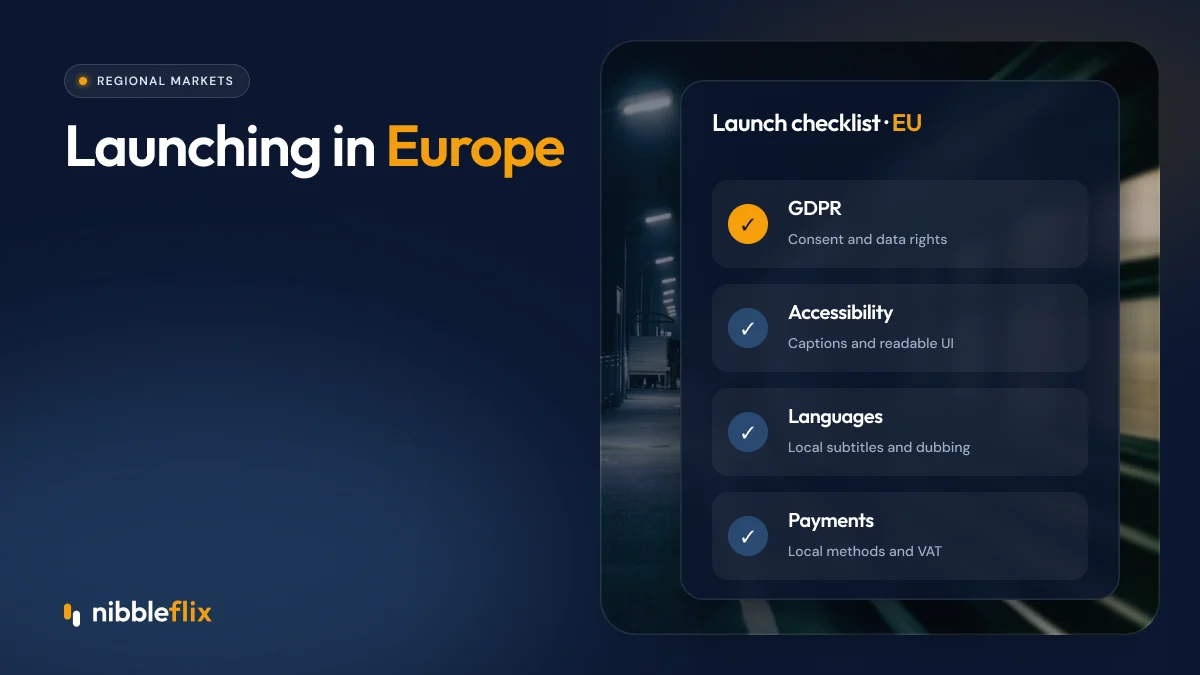
The short answer: to launch a streaming service in Europe, you need GDPR-compliant data practices, awareness of the AVMSD and the European Accessibility Act, localization for each target market, correct VAT handling and local payment methods.
This guide walks through each of these in plain language.
The European OTT market at a glance
The European OTT market includes mature subscription markets such as the UK, the Nordics and Germany, plus fast-growing ad-supported viewing. According to valantic and FUNKE data reported by Señal News, European FAST revenue reached €1.34 billion in 2025 and is forecast to reach €3.04 billion in 2030, with 167 million FAST users in 2025.
The same research found that 71% of connected TV users in the DACH region accept ads in exchange for free content. Omdia forecasts UK FAST revenue above US$500 million in 2027, with Germany just over US$200 million.
The message is clear: subscriptions remain important, but free and hybrid models are now a major part of the European opportunity. See our guide to FAST channels in Europe for more.
GDPR streaming requirements
GDPR applies to any service that offers content to people in the EU, wherever the company is based. For streaming services, the main points are:
- Lawful basis: know why you process each type of viewer data.
- Consent: get clear consent for analytics cookies, ad tracking and marketing.
- Viewer rights: support access, correction, deletion and data portability requests.
- Data transfers: use approved safeguards when data leaves the EU.
- Children’s data: take extra care with kids’ profiles and age checks.
Owning your viewer data is a strength under GDPR, because you control how it is collected and used. NibbleFlix apps are fully white-label, so the viewer data is yours, not shared with a marketplace.
AVMSD: rules for on-demand services
The Audiovisual Media Services Directive (AVMSD) sets common EU rules for TV and on-demand services. Each country turns it into national law, and you are mainly regulated by the country where you are established.
Key points for streaming services include:
- European works: on-demand catalogs must give European works a share of the catalog and prominence.
- Investment obligations: some countries ask services to invest in local production.
- Protection of minors: age ratings, parental controls and PINs for mature content.
- Advertising rules: limits on certain products and clear separation of ads.
Many countries exempt small services with low turnover or audiences, so check thresholds before you plan quotas.
European Accessibility Act and video
The European Accessibility Act video requirements apply to services providing access to audiovisual media, and they have applied since June 2025. Apps, websites and programme guides need to be usable by people with disabilities.
In practice, plan for screen reader support, clear focus states on TV apps, readable text, captions and subtitles, and audio description where available. AI subtitles make it much easier to caption a full catalog. NibbleFlix includes AI subtitles in 12 languages and AI dubbing as part of its AI streaming tools.
Languages and localization
The EU has 24 official languages, and viewers expect content and interfaces in their own. A practical approach:
- Start with a few priority markets rather than all of Europe at once.
- Localize the interface, store listings and metadata for each market.
- Add subtitles first, then dubbing for markets where dubbing is the norm, such as Germany, France, Italy and Spain.
- Use territory rules so each title only appears where you hold rights.
Smaller language markets are often overlooked. Viewers in Poland, Czechia, Portugal or Greece may have fewer local-language options, which gives focused services a chance to stand out. AI metadata generation also helps, because titles, descriptions and tags can be produced in each language without a large editorial team.
Payments, pricing and VAT
Payment habits vary a lot across Europe. Cards dominate in some markets, while others rely on local methods. Plan for these:
| Market | Popular methods | Notes |
|---|---|---|
| Netherlands | iDEAL, cards | Local bank payments are widely used |
| Germany | SEPA Direct Debit, PayPal, cards | Viewers value privacy and clear cancellation |
| Belgium | Bancontact, cards | Bancontact is a common local card scheme |
| Nordics | Cards, mobile wallets | High digital payment adoption |
| UK | Cards, wallets | Outside the EU; UK GDPR and Ofcom rules apply |
For VAT, digital services are generally taxed at the rate of the viewer’s country. The EU One Stop Shop scheme lets you report this in one place. Online card payments must also support strong customer authentication. Inside mobile apps, Apple and Google billing handle much of this for you, with a commission of up to 30%.
Price in EUR (and GBP for the UK), and test local price points. NibbleFlix supports subscriptions, ads, rentals, pay-per-episode and hybrid models; see our monetization options.
How to launch a streaming service in Europe with NibbleFlix
NibbleFlix lets you launch your own white-label streaming app in 7 days, on iOS, Android, web, PWA and smart TVs including Samsung, LG, Android TV, Apple TV, Fire TV and Roku. No code and no in-house tech team are needed. FAST channels get EPG and server-side ad insertion built in, and existing services can migrate without viewer downtime.
Key takeaways
- GDPR applies to any service offered to EU viewers, wherever you are based.
- The AVMSD covers European works, minors and ads, with exemptions for small services.
- The European Accessibility Act makes accessible apps and subtitles a requirement.
- Localize market by market, starting with your priority countries.
- Local payment methods and correct VAT handling raise conversion and reduce risk.
Ready to plan your European launch? Book a demo and we will walk you through it.
Frequently asked questions
Does GDPR apply to a streaming service based outside the EU?
Yes, if you offer your service to people in the EU or monitor their behaviour. GDPR follows the viewer, not the company’s address. You need a lawful basis for processing, clear consent for tracking and marketing, data subject rights handling and appropriate safeguards for data transferred outside the EU.
What is the AVMSD and does it apply to small services?
The Audiovisual Media Services Directive sets EU rules for TV and on-demand services, including protection of minors, advertising limits and promotion of European works. Countries apply it through national law, and many offer exemptions for services with low turnover or small audiences. Check the rules in your country of establishment.
Does the European Accessibility Act cover streaming apps?
The European Accessibility Act applies to services giving access to audiovisual media, including websites, apps and electronic programme guides, and has applied since June 2025. Requirements include accessible interfaces and support for access services such as subtitles and audio description. Some microenterprises are exempt from parts of it.
Which payment methods should a European streaming service offer?
Cards and app store billing cover most viewers, but local methods raise conversion in several markets. Examples include iDEAL in the Netherlands, Bancontact in Belgium, SEPA Direct Debit across the euro area and popular wallets. Online card payments also need strong customer authentication under PSD2.