
In this article
- The APAC OTT market: why it matters
- Korea: K-drama streaming app opportunities
- What Korean viewers expect
- Korean content licensing
- Japan streaming market: what is different
- Southeast Asia: mobile-first and fast-growing
- Comparing Asia Pacific markets
- Common mistakes when entering the region
- Treating the region as one market
- Relying only on subscriptions
- Ignoring time zones and release timing
- Skipping native review of translations
- Building a streaming app in Asia Pacific with NibbleFlix
- Key takeaways
- Frequently asked questions
- Is Asia Pacific a good region to launch a streaming app?
- How do I license Korean content for my streaming app?
- What payment methods matter in Asia Pacific?
- Should I build separate apps for each APAC country?
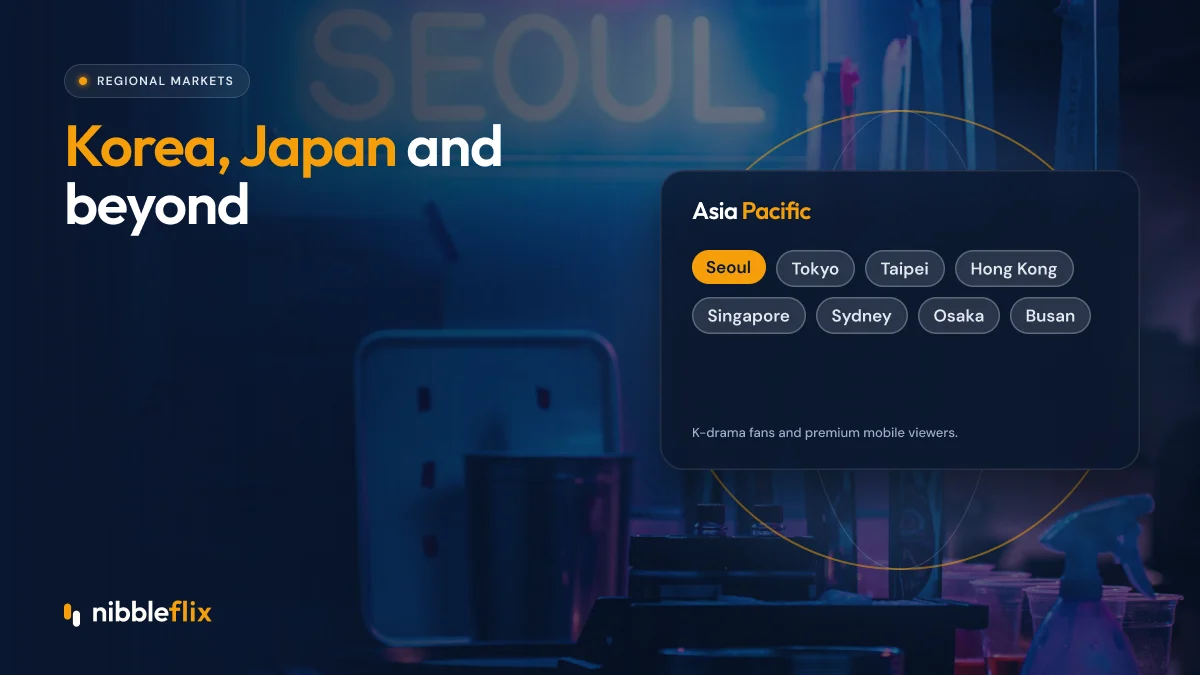
Asia Pacific is home to some of the world’s most influential entertainment. K-dramas, Japanese anime and short vertical dramas all have huge fan bases, and viewers in the region are among the most mobile-first anywhere. For founders, launching a streaming app in Asia Pacific offers big audiences, but each market works differently.
The short answer: a successful streaming app in Asia Pacific starts with one or two focus markets, localized content and interfaces, payment options that match local habits, and a mobile-first product with short-form and episodic formats.
This guide looks at Korea, Japan and Southeast Asia, and what new platforms need to plan for in each.
The APAC OTT market: why it matters
The APAC OTT market combines rich, high-spending markets with fast-growing, mobile-first ones. Short drama shows the opportunity clearly. Sensor Tower reports that Southeast Asia accounted for 32% of short drama app downloads in Q1 2026, with triple-digit growth year over year, and viewers there spend nearly 40 minutes a day in short drama apps.
Monetization is strong as well. Adjust data reported by PPC Land puts APAC short drama revenue per monthly active user at $1.45, well above the figure reported for MENA.
The region rewards services that understand local viewing habits instead of copying one global playbook.
Korea: K-drama streaming app opportunities
Korean storytelling is one of the most exported forms of entertainment in the world. A K-drama streaming app can serve fans in Korea, across Asia and in diaspora and fan communities in Latin America, Europe and the Middle East.
What Korean viewers expect
- Fast release schedules, often close to broadcast.
- High production quality and polished apps.
- Strong social features and fan engagement.
- Local payment options alongside app store billing.
Korean content licensing
Korean content licensing usually happens through broadcasters, studios and distributors, by territory and window. New prime-time series are expensive, so smaller services often start with library titles, web dramas, webtoon-based adaptations or short vertical series. Read our guide to micro-drama content licensing for more on rights and deal terms.
Japan streaming market: what is different
The Japan streaming market is large and mature, with high spending per viewer. Anime, domestic dramas, variety shows and live events all have strong audiences.
Japanese viewers value reliability, clear interfaces and careful localization. Machine-translated menus and subtitles stand out quickly, so review AI output with native speakers. Payment habits also differ: carrier billing and convenience-store payments are common alongside cards and app store billing.
Smart TV viewing is important in Japan, so plan TV apps early. See the supported devices for TV coverage.
Southeast Asia: mobile-first and fast-growing
Indonesia, the Philippines, Vietnam, Thailand and Malaysia have large, young audiences who watch mostly on phones. Short drama is booming, and price sensitivity is high.
What works in Southeast Asia:
- Free first episodes to remove the barrier to trying a series.
- Coins, VIP passes and ad unlocks instead of only monthly subscriptions.
- Local language subtitles and dubbing, especially Bahasa Indonesia, Thai, Vietnamese and Filipino.
- E-wallet and prepaid options for viewers without credit cards.
Our guide to short drama apps in Southeast Asia goes deeper into this market.
Comparing Asia Pacific markets
| Market | Content strengths | Monetization fit | Key consideration |
|---|---|---|---|
| Korea | K-drama, variety, web dramas | Subscriptions, pay-per-episode | Fast releases, high quality bar |
| Japan | Anime, drama, live events | Subscriptions, rentals | Careful localization, TV apps |
| Southeast Asia | Short drama, local series, Korean content | Coins, ads, VIP passes | Price sensitivity, e-wallets |
| Australia and New Zealand | English-language and niche content | Subscriptions, FAST | Strong connected TV use |
Common mistakes when entering the region
Many services underestimate how different Asia Pacific markets are from each other. These are the mistakes we see most often.
Treating the region as one market
A price, catalog and marketing message that works in Seoul will rarely work in Jakarta or Manila. Set prices, featured rows and promotions per country, even if the app itself is shared.
Relying only on subscriptions
Monthly plans suit Korea, Japan and Australia, but many Southeast Asian viewers prefer to pay small amounts for what they watch. Coins, pay-per-episode and ad-supported access widen your audience. Our guide to monetization options shows how to combine them.
Ignoring time zones and release timing
Fans expect new episodes at predictable times in their own time zone. Scheduled releases and push alerts timed for evening commutes or late-night viewing make a measurable difference to how often viewers return.
Skipping native review of translations
AI translation saves time and money, but a quick review by native speakers protects your brand, especially for titles, character names and jokes.
Building a streaming app in Asia Pacific with NibbleFlix
NibbleFlix is a white-label streaming platform that lets you launch your own streaming app in 7 days, from sign-up to App Store and Google Play submission. No code or in-house tech team is needed, and launch support is included.
For micro-dramas, you get a vertical 9:16 player with swipe navigation, first episodes free, and unlocks by coins, VIP pass or watching an ad. Daily check-in rewards and new-episode push alerts keep viewers coming back. See the micro-drama solution for details.
For localization across the region, AI subtitles cover 12 languages, alongside AI dubbing and AI metadata generation. Your apps run on iOS, Android, web, PWA and smart TVs, under your brand and store listings, with your viewer data and your revenue.
Key takeaways
- A streaming app in Asia Pacific should start with one or two focus markets.
- Korea rewards fast releases and quality; licensing is by territory and window.
- Japan needs careful localization, local payments and strong TV apps.
- Southeast Asia is mobile-first, price-sensitive and booming for short drama.
- Hybrid monetization and AI localization help one app serve many markets.
Ready to launch across Asia Pacific? Book a demo and see how fast you can go live.
Frequently asked questions
Is Asia Pacific a good region to launch a streaming app?
Yes, especially for mobile-first formats. Short drama is growing fast across the region, and Sensor Tower data shows Southeast Asia accounted for 32% of short drama app downloads in Q1 2026. Korea and Japan bring high spending power, while Southeast Asia brings large audiences and very long daily viewing times.
How do I license Korean content for my streaming app?
Korean dramas and films are usually licensed from broadcasters, studios or distributors, by territory and time window. Smaller services often start with library titles, web dramas or short-form series, which cost less than new prime-time releases. Always confirm territory, language, platform and exclusivity terms in writing before launch.
What payment methods matter in Asia Pacific?
It varies by country. App store billing works almost everywhere on phones. Japan has strong carrier billing and convenience-store payments, Korea uses local payment apps widely, and Southeast Asian viewers often prefer e-wallets and prepaid options. Offering ad-supported or coin-based access helps convert viewers who do not hold credit cards.
Should I build separate apps for each APAC country?
Usually not. One app with localized interfaces, metadata, subtitles, pricing and territory rules is easier to run and update. Separate brands only make sense when audiences, content and positioning are completely different. A white-label platform lets you manage several branded apps from one dashboard if you do need them.