
In this article
- The MENA streaming market in numbers
- Middle East OTT market: country by country
- Saudi streaming app opportunities
- UAE streaming market opportunities
- Where new platforms can win
- Building an Arabic streaming platform
- Monetization models that work in MENA
- Challenges to plan for
- Competition for attention
- Payments and pricing
- Content standards and ratings
- How to launch in the MENA streaming market
- Key takeaways
- Frequently asked questions
- How big is the MENA streaming market?
- Which MENA countries should a new platform target first?
- Do I need Arabic content to succeed in MENA?
- Is short drama popular in the Middle East?
The MENA streaming market has moved from early adoption to real scale. Large regional and global platforms are well established, but viewer demand is growing faster than any one service can serve, especially for niche, local and short-form content.
The short answer: the MENA streaming market is worth well over a billion dollars and still growing, and new platforms can win by focusing on specific audiences, Arabic-first experiences, mobile and short-form formats, and flexible pricing across very different countries.
This guide covers the key numbers, the main country markets, and where the gaps are for new services.
The MENA streaming market in numbers
According to Omdia, the MENA streaming video market was projected to pass US$1.5 billion by the end of 2025, with more than 27 million SVOD subscriptions. Omdia forecasts online video revenue in the region reaching US$8.4 billion by 2029.
Short-form video is growing even faster. Adjust data reported by PPC Land shows MENA short drama app installs up 323% year over year in Q1 2026, with revenue per monthly active user rising from $0.38 to $0.43.
Together, these numbers point to a region where both long-form subscriptions and mobile-first formats are expanding at the same time.
Middle East OTT market: country by country
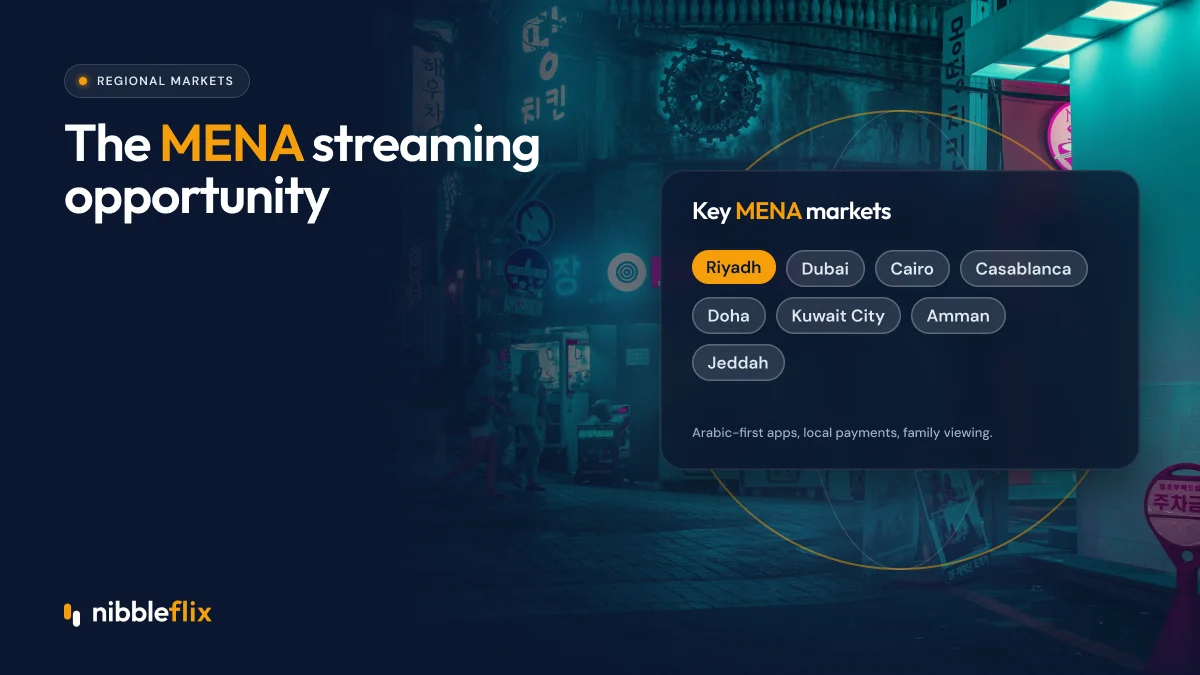
The Middle East OTT market is not one market. Spending power, payment habits and content tastes vary a lot from country to country.
| Market | Strengths | What to plan for |
|---|---|---|
| Saudi Arabia | Large, young, mobile-first population; strong spending | Arabic-first UX, local content, content rating rules |
| UAE | High income, very international audience | Multiple languages, premium pricing, English and Arabic content |
| Egypt | Very large audience, strong film and drama tradition | Lower price points, ad-supported tiers, flexible payments |
| Morocco, Algeria, Tunisia | Growing mobile audiences | French and Arabic, price-sensitive viewers |
| Kuwait, Qatar, Bahrain, Oman | Smaller but high-value markets | Premium positioning, Gulf-focused content |
Saudi streaming app opportunities
A Saudi streaming app can target a very young, highly connected population that watches heavily on phones. Local stories, sports, family content and religious or cultural programming all have strong demand. Content must respect local standards and ratings.
UAE streaming market opportunities
The UAE streaming market is shaped by its international population. Viewers watch in Arabic, English and many other languages, so multi-language subtitles and audio tracks are a real advantage. Premium pricing is more acceptable here than in most of the region.
Where new platforms can win
Large services compete on broad catalogs. New platforms win by being more focused. Promising openings include:
- Arabic micro-dramas: short vertical series made for phones, monetized with coins, VIP passes and ads.
- Niche communities: faith, kids, education, regional dialects, sports clubs or diaspora audiences.
- Broadcaster and producer catalogs: TV groups and studios launching direct-to-consumer apps.
- FAST channels: free, ad-supported linear channels for smart TV viewers.
- Seasonal peaks: Ramadan is the biggest viewing season of the year, and a strong release plan around it can drive sign-ups.
For short-form ideas, see our guide on how micro-drama apps make money.
Building an Arabic streaming platform
An Arabic streaming platform needs more than translated menus. Plan for:
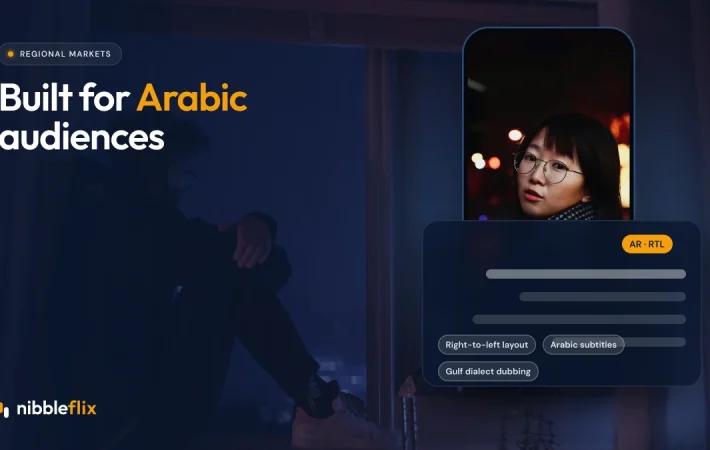
- Right-to-left layouts across mobile, web and TV apps.
- Arabic metadata and search, so viewers can find titles in their own language.
- Subtitles and dubbing for international titles, and English subtitles for Arabic originals.
- Local payments and pricing that fits each country.
AI tools now make localization faster and cheaper. NibbleFlix includes AI subtitles in 12 languages, AI dubbing and AI metadata generation. Read more in our guide to Arabic localization for streaming apps, or see the AI streaming tools.
Monetization models that work in MENA
Pricing tolerance in Riyadh or Dubai is very different from Cairo or Casablanca. Hybrid models let you serve both from one app:
- Premium subscriptions for Gulf viewers.
- Free, ad-supported viewing for price-sensitive markets.
- Pay-per-episode, coins and VIP passes for micro-dramas.
- Rentals for new films and one-off events.
NibbleFlix supports SVOD, AVOD, TVOD, pay-per-episode, coins, in-app purchases and promotional offers, and you can combine them in one app. See the full list of monetization options.
Challenges to plan for
The opportunity is real, but new services should go in with clear eyes. Three challenges come up most often.
Competition for attention
Established regional platforms and global services already have large catalogs and big marketing budgets. Competing head on with a general entertainment catalog is expensive. A clear niche, a distinctive format or a loyal existing audience gives you a much better starting position.
Payments and pricing
Card use varies widely across the region. In some markets, many viewers prefer mobile wallets or carrier billing, while app store billing is the simplest route on phones. Test price points per country rather than copying one price across the whole region.
Content standards and ratings
Each country has its own expectations around content, age ratings and cultural sensitivities. Review your catalog market by market, use clear age ratings, and use territory rules in your CMS so each title only appears where it is suitable and licensed.
How to launch in the MENA streaming market
With NibbleFlix, you can launch your own fully white-label streaming app in 7 days, from sign-up to App Store and Google Play submission. Your brand, your store listings, your viewer data and your revenue. Apps cover iOS, Android, web, PWA and smart TVs, and no code or in-house tech team is needed. Launch support is included.
Our founding partner program locks launch pricing for the first year, assigns a dedicated launch manager and prioritizes your feature requests on the roadmap.
Key takeaways
- Omdia expects MENA online video revenue to reach US$8.4 billion by 2029.
- Short drama installs in MENA grew 323% year over year in Q1 2026.
- Saudi Arabia, the UAE and Egypt each need a different pricing and content approach.
- Arabic-first UX, localization and hybrid monetization are the foundations.
- Focused, niche and mobile-first services have the most room to grow in the MENA streaming market.
Planning a launch in the Middle East or North Africa? Book a demo and we will map out your first 7 days.
Frequently asked questions
How big is the MENA streaming market?
Omdia projected the MENA streaming video market would pass US$1.5 billion by the end of 2025, with more than 27 million SVOD subscriptions. It forecasts online video revenue in the region reaching US$8.4 billion by 2029, which points to strong growth across subscriptions, advertising and transactional models.
Which MENA countries should a new platform target first?
Saudi Arabia and the UAE are the usual starting points because of high smartphone use, strong spending power and good payment infrastructure. Egypt brings a very large audience and a deep content tradition. Many services launch in the Gulf first, then expand to North Africa with adjusted pricing and ad-supported tiers.
Do I need Arabic content to succeed in MENA?
Arabic content and a full Arabic interface make a big difference to discovery and retention. That does not mean every title must be original Arabic production. Many services combine local originals with international content that is subtitled or dubbed into Arabic, often using AI tools to speed up localization.
Is short drama popular in the Middle East?
Yes, and it is growing quickly. Adjust data reported by PPC Land shows MENA short drama app installs up 323% year over year in Q1 2026, with revenue per monthly active user also rising. Vertical drama is a good fit for the region’s mobile-first viewers and high social media use.