
In this article
- What DRM for OTT actually does
- Widevine, FairPlay and PlayReady explained
- Security levels and HD content
- Why multi-DRM is the standard
- Video content protection beyond DRM
- Token authentication
- Concurrent stream limits
- Geo-restriction
- Forensic watermarking
- Secure offline downloads
- Output protection
- Monitoring and takedowns
- Streaming piracy risks by content type
- Questions to ask your OTT platform about DRM
- Key takeaways
- Frequently asked questions
- Do I need DRM for my streaming service?
- What is the difference between Widevine, FairPlay and PlayReady?
- Can DRM stop all piracy?
- Does DRM affect the viewer experience?
Piracy costs streaming services money and makes rights holders nervous. If you license films, series or sports, you will almost certainly be asked how you protect them. That is where DRM for OTT comes in.
The short answer: DRM (digital rights management) encrypts your video and only lets approved devices and apps decrypt it, using a licence that checks who the viewer is and what they are allowed to watch.
This guide explains how DRM works, the three main systems, why most services use multi-DRM, and the other layers that reduce streaming piracy.
What DRM for OTT actually does
Without protection, a video stream is just a set of files. Anyone who finds the URL can download and share them. DRM changes that by encrypting the video and controlling who gets the key.
The process works in four steps:
- Encryption: the video is encrypted when it is packaged for streaming.
- Request: when a viewer presses play, the player asks a licence server for a key.
- Check: the licence server confirms the viewer is signed in and entitled to that title.
- Playback: the device decrypts the video inside a protected environment and plays it, without exposing the key.
The licence can also carry rules, such as how long a rental lasts, whether downloads are allowed, or the maximum resolution on a less secure device.
Widevine, FairPlay and PlayReady explained
There is no single DRM that works everywhere. Each major technology company has its own system, and each device supports one or more of them.
| DRM system | Owner | Main devices and browsers |
|---|---|---|
| Widevine | Android phones, Android TV, Chrome, Firefox, many smart TVs and set-top boxes | |
| FairPlay | Apple | iPhone, iPad, Apple TV, Mac and Safari |
| PlayReady | Microsoft | Windows, Edge, Xbox, many smart TVs |
Security levels and HD content
DRM systems have security levels. Widevine, for example, has a hardware-backed level and a software-only level. Studios often allow HD and 4K playback only on hardware-backed devices, with lower resolutions elsewhere. Your player and licence rules should handle this automatically.
Why multi-DRM is the standard
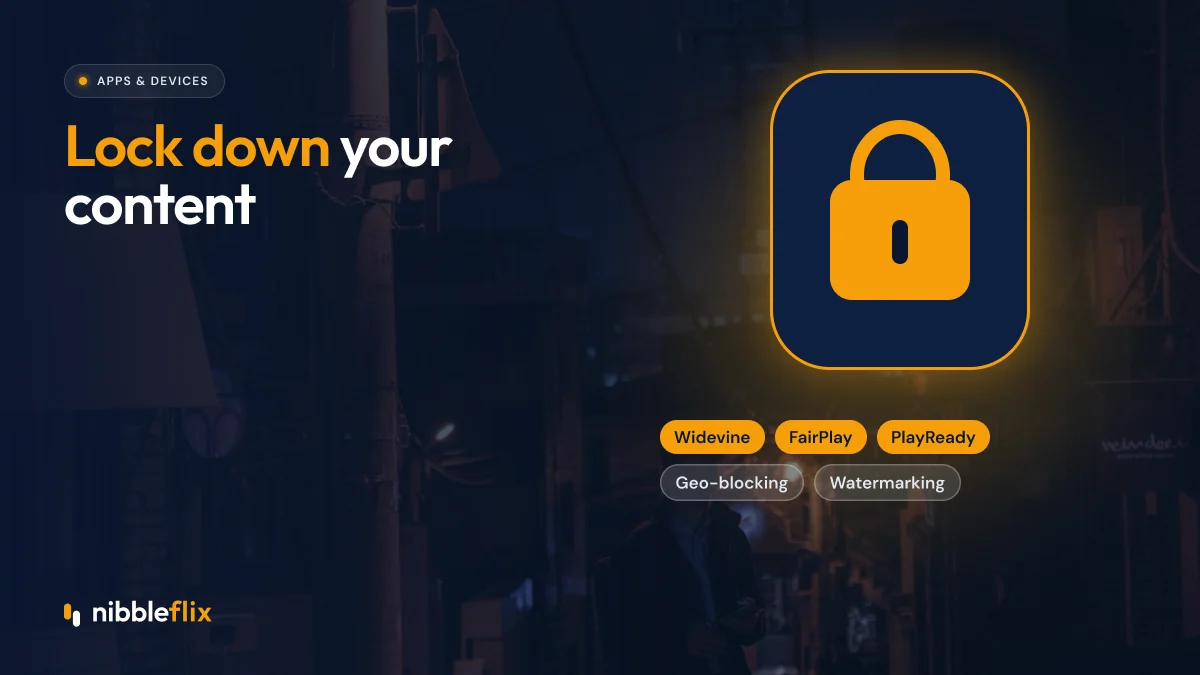
Because no single system covers every device, most services use multi-DRM. Content is encrypted once using a common encryption standard, then licences are issued for Widevine, FairPlay or PlayReady depending on the device.
Multi-DRM brings three practical benefits:
- Reach: one catalog plays on phones, browsers and TVs.
- Simpler storage: modern packaging formats let you store one encrypted copy for many devices.
- Licensing compliance: it meets the protection requirements in most studio and distributor contracts.
Make sure DRM coverage matches every app you plan to launch. A smart TV app without the right DRM may be limited to lower-value content. See the full range of supported devices when planning coverage.
Video content protection beyond DRM
DRM is the core of video content protection, but it is not the only layer. Strong services combine several measures.
Token authentication
Short-lived, signed URLs stop people from sharing stream links. Even if a link is copied, it expires quickly.
Concurrent stream limits
Limiting how many devices can play at the same time on one account reduces password sharing and resale of logins.
Geo-restriction
Rights are often licensed by territory. Geo-blocking makes sure each title only plays where you hold rights, which matters for services serving Europe, Latin America, MENA and Asia Pacific at once.
Forensic watermarking
Invisible watermarks tie each stream to a viewer or session. If a copy appears online, you can trace the source and close the account.
Secure offline downloads
Downloads are popular with commuters and viewers on limited mobile data. Protected downloads stay encrypted on the device, and the licence sets how long they can be watched before the app must check in again. When a subscription ends, downloaded titles stop playing.
Output protection
Output protection such as HDCP checks the connection between a device and the screen. It stops high-resolution video from being sent to recording hardware through a cable, and many studio contracts require it for HD and 4K playback.
Monitoring and takedowns
Monitor piracy sites, social platforms and messaging channels for leaks, and send takedown notices quickly. Speed matters most in the first days after a release.
Streaming piracy risks by content type
Not every catalog needs the same level of protection. Match your security to the value of your content.
- Premium licensed films and series: full multi-DRM, hardware security for HD, watermarking.
- Live sports and events: DRM, token authentication, real-time monitoring and fast takedowns.
- Micro-dramas and short originals: encryption, tokens and stream limits, since clips spread quickly on social media. Our guide on micro-drama content licensing covers rights in more detail.
- Free and FAST channels: lighter protection, focused on ad integrity and geo-rules.
Questions to ask your OTT platform about DRM
When you compare platforms, ask direct questions about how DRM for OTT is handled:
- Which DRM systems are supported on each app and device?
- Can licence rules control rentals, downloads and resolution?
- Are concurrent stream limits and geo-restrictions configurable without code?
- How are content keys stored and rotated?
- Is watermarking available for premium titles?
NibbleFlix is a white-label streaming platform for launching your own branded apps on iOS, Android, web, PWA and smart TVs, all managed from one admin dashboard and CMS. Talk to us about your rights holder requirements during your demo, and review the platform features to see how apps, monetization and content management fit together.
Key takeaways
- DRM encrypts video and only lets approved, entitled devices decrypt it.
- Widevine, FairPlay and PlayReady together cover nearly all major devices.
- Multi-DRM is the standard for services that stream on phones, web and TVs.
- Tokens, stream limits, geo-rules and watermarking add important extra layers.
- Match protection to content value, from premium films to free channels.
Planning a service with licensed content? Book a demo and bring your rights holder requirements to the call.
Frequently asked questions
Do I need DRM for my streaming service?
If you license premium content from studios or distributors, DRM is usually a contract requirement. For original or low-value content, lighter protection such as encryption with tokens may be enough at first. Most paid services use DRM because it protects revenue and reassures rights holders that their titles are handled properly.
What is the difference between Widevine, FairPlay and PlayReady?
They are DRM systems from Google, Apple and Microsoft. Widevine covers Android, Chrome and many smart TVs. FairPlay covers iPhone, iPad, Apple TV and Safari. PlayReady covers Windows, Edge, Xbox and many smart TVs. To reach every major device, a streaming service normally supports all three through multi-DRM.
Can DRM stop all piracy?
No. DRM makes copying harder and stops casual sharing, but determined pirates may still record screens or capture streams. That is why services add forensic watermarking, concurrent stream limits, token authentication and takedown monitoring. The goal is to make piracy costly and traceable, not to make it impossible.
Does DRM affect the viewer experience?
When set up well, viewers do not notice DRM at all. Problems appear when a device lacks a supported DRM system, licences expire during downloads, or HD playback needs hardware security the device does not have. Testing across devices before launch avoids most of these issues and support complaints.