
In this article
- Why short drama apps in Southeast Asia are growing so fast
- What viewers actually watch
- The SEA streaming market country by country
- Micro drama in Indonesia
- Vertical drama in Thailand and the Philippines
- Short drama app Vietnam and Malaysia
- How short drama apps in Southeast Asia make money
- Localization: the make-or-break factor
- How to launch a short drama app for Southeast Asia
- Risks to plan for
- Key takeaways
- Frequently asked questions
- Which Southeast Asian country is best for a short drama app launch?
- Do short drama apps in Southeast Asia need local content?
- How should I price coins and VIP passes in the region?
- How long does it take to launch a micro-drama app for SEA?
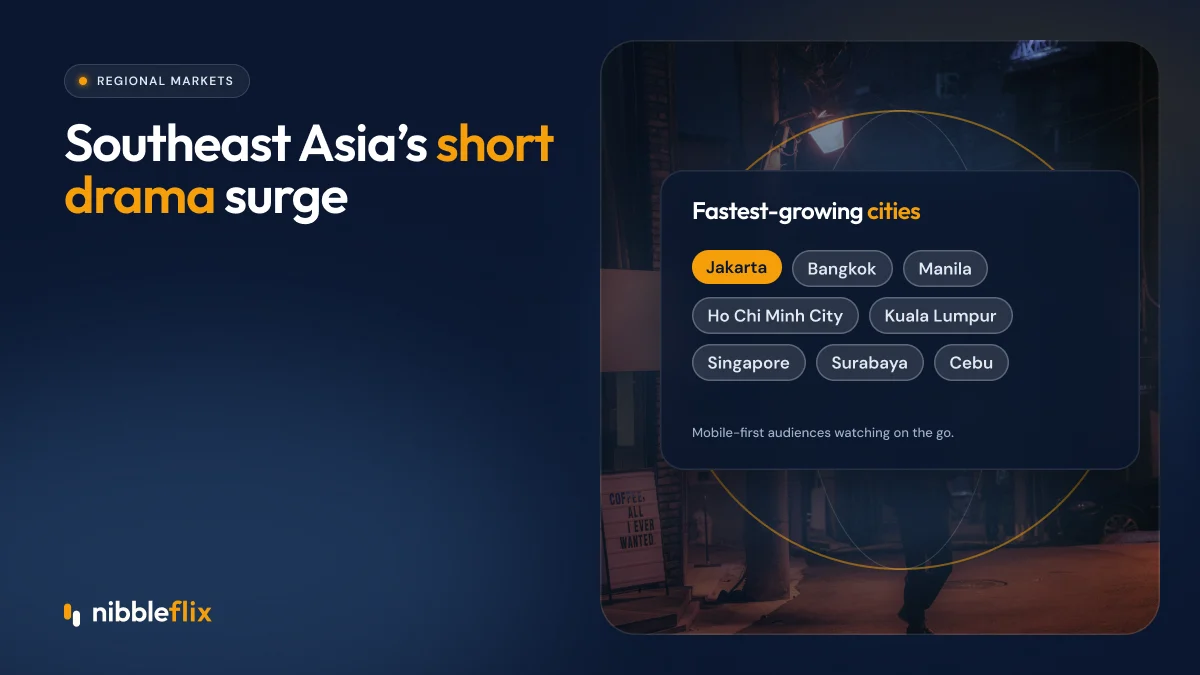
Short drama apps in Southeast Asia have moved from a niche habit to one of the fastest growing corners of mobile entertainment. Viewers in Indonesia, the Philippines, Thailand and Vietnam now spend more time with two-minute vertical episodes than most Western markets do.
The direct answer: Southeast Asia is the largest and most engaged region for short drama apps in 2026, which makes it a strong first market for a new micro-drama service if you localize content and price for mobile wallets.
This guide covers the numbers, country differences, monetization choices and a practical launch plan for founders and content owners looking at the region.
Why short drama apps in Southeast Asia are growing so fast
The region has a young, mobile-first audience, cheap data, and a long tradition of serialized TV drama. Short drama apps package that same appetite for cliffhangers into a format built for phones and commutes.
The data backs this up. According to Sensor Tower’s State of Short Drama Apps 2026 report, Southeast Asia accounted for 32% of short drama app downloads in Q1 2026, with triple-digit year-over-year growth. The same report found that viewers in Southeast Asia spend nearly 40 minutes a day in these apps, well above the global average of 25 minutes.
Time spent matters more than installs. Forty minutes a day is more than many people give to traditional OTT services, and it creates room for ads, coin purchases and VIP passes.
What viewers actually watch
- Romance and revenge stories with fast reversals in every episode
- Family and inheritance drama with clear villains
- Fantasy and time-travel plots, often adapted from web novels
- Local remakes of formats that worked in China, Korea or the US
The SEA streaming market country by country
Southeast Asia is not one market. Language, payment habits and censorship rules change at every border, so a single regional app usually needs per-country settings.
Micro drama in Indonesia
Indonesia is the volume play. It has the biggest population in the region and heavy Android usage, so ad-supported viewing and low-priced coin packs tend to outperform subscriptions. Bahasa Indonesia subtitles or dubbing are close to essential.
Vertical drama in Thailand and the Philippines
Thailand has a strong local drama industry and audiences who already follow serialized romance, which makes original vertical drama a natural extension. The Philippines is English-friendly, so imported English titles can work alongside Filipino originals, and the audience is highly social, which helps word-of-mouth growth.
Short drama app Vietnam and Malaysia
A short drama app in Vietnam needs Vietnamese localization and close attention to local content rules. Malaysia is multilingual, so offering Malay, English and Chinese subtitles in one app widens reach without extra production.
| Market | Main language need | Likely model | Content angle |
|---|---|---|---|
| Indonesia | Bahasa Indonesia | Ads plus small coin packs | Romance, family drama |
| Philippines | English, Filipino | Hybrid: ads and VIP pass | Imported English and local originals |
| Thailand | Thai | Coins and VIP pass | Local romance originals |
| Vietnam | Vietnamese | Ads plus coins | Dubbed Chinese and Korean titles |
| Malaysia | Malay, English, Chinese | Hybrid | Multi-language catalog |
How short drama apps in Southeast Asia make money
Most successful apps use the same basic funnel: the first episodes are free, then viewers unlock the rest with coins, a VIP pass, or by watching an ad. The mix you choose should reflect local spending power.
Revenue per user in the region is still building. The Adjust Short Drama Apps Report puts APAC revenue per monthly active user at $1.45, which shows money is there, but you will usually earn it from a wide base of light spenders rather than a few heavy ones. That is why many SEA apps lean on hybrid monetization.
- Free hook: give away the first five to ten episodes to build the habit.
- Ad unlock: let non-payers unlock an episode by watching a rewarded ad.
- Coins: sell small coin packs priced for local wallets, from about US$0.99.
- VIP pass: offer weekly or monthly passes for heavy viewers.
- Retention rewards: daily check-in coins and new-episode push alerts keep people coming back.
For a deeper look at the economics, read our guide on how micro-drama apps make money from 2-minute episodes and the full list of monetization options.
Localization: the make-or-break factor
Viewers in the region will try an app in English, but they stay for content in their own language. Localization used to mean months of subtitle and dubbing work per title. AI tools have changed that.
- AI subtitles in 12 languages let you test a title in several countries at once.
- AI dubbing helps in markets where viewers prefer audio in their own language, such as Indonesia and Vietnam.
- AI metadata writes local titles, descriptions and tags so your catalog is searchable in each language.
- AI trailers of about two minutes give you ad creative for every new series.
You can see how these fit together on our AI streaming solution page.
How to launch a short drama app for Southeast Asia
You do not need a large engineering team to enter the region. A white-label platform gives you a branded app with a vertical 9:16 player and swipe navigation, and your store listings sit under your own name.
A typical seven-day plan looks like this:
- Day 1: set up your brand, colors and app icon.
- Days 2 to 3: upload your first series and localized subtitles.
- Day 4: set coin prices, VIP passes and ad unlock rules per country.
- Days 5 to 6: test on Android devices common in the region.
- Day 7: submit to Google Play and the App Store.
The NibbleFlix micro-drama solution covers each of these steps, with launch support included. If you are also looking at other regions, our guide to micro drama in Latin America compares a market with similar growth.
Risks to plan for
Growth attracts competition. Global players already spend heavily on user acquisition in the region, so a new app should compete on local stories and language rather than on ad budget alone.
Content rules differ by country, and some markets restrict certain themes. Build a review step into your release schedule. Payment friction is the other big risk: many viewers do not use credit cards, so check which store billing and local payment options your audience actually uses.
Key takeaways
- Short drama apps in Southeast Asia lead the world on daily viewing time.
- Each country needs its own language, pricing and content mix.
- Hybrid monetization with free episodes, ad unlocks, coins and VIP passes fits regional spending.
- AI subtitles and dubbing make multi-country launches realistic for small teams.
- A white-label platform can get you to the app stores in about seven days.
Ready to test the region with your own branded app? Book a demo and we will walk you through a Southeast Asia launch plan.
Frequently asked questions
Which Southeast Asian country is best for a short drama app launch?
Indonesia offers the largest audience, while the Philippines is easiest for English content. Many founders start with one anchor market, learn what pricing and genres work, then add Thailand, Vietnam or Malaysia with localized subtitles. Starting narrow keeps acquisition costs and content review manageable in the first months.
Do short drama apps in Southeast Asia need local content?
Imported Chinese, Korean and English titles can work well when subtitled or dubbed, so you do not need originals on day one. Over time, local productions tend to build stronger loyalty and stand out against global apps. A mix of licensed catalog and a few local originals is a common path.
How should I price coins and VIP passes in the region?
Price for mobile wallets and low card usage. Small coin packs from about US$0.99 and short weekly VIP passes usually convert better than large bundles. Always keep a free path through rewarded ads, because many viewers will never pay but still generate ad revenue for your app.
How long does it take to launch a micro-drama app for SEA?
With a white-label platform, you can go from sign-up to App Store and Google Play submission in about seven days. Store review times vary, and localization of your first titles may add a few days, but you do not need to build an app or hire developers.