
In this article
- The size of the opportunity
- FAST in Brazil
- FAST in Mexico
- Spanish FAST channel vs Portuguese: planning the region
- What content works for free streaming TV in Latin America
- Launching FAST channels Latin America viewers will watch
- Common mistakes to avoid
- Launching with NibbleFlix
- Key takeaways
- Frequently asked questions
- How big is the FAST market in Latin America?
- Should I launch in Spanish or Portuguese first?
- What genres work best for FAST in Latin America?
- Do I need local ad partners in Latin America?
Free TV has always been central to viewing in Latin America, which is why FAST channels Latin America audiences can watch on smart TVs are a natural next step. Connected TVs are spreading quickly in big cities, and viewers who grew up with broadcast television find a channel grid instantly familiar.
The short answer: Latin America is one of the most promising FAST regions outside the US, led by Brazil and Mexico, and content owners can win there with Spanish and Portuguese channels built around clear genres, local scheduling and reliable ad insertion.
This guide covers the market size, the leading countries, the content that works and the steps to launch.
The size of the opportunity
Omdia forecasts reported by Digital TV Europe put Latin American FAST revenue at US$207 million in 2027. Brazil accounts for about US$100 million of that and Mexico for US$93 million. Both countries also appear on Omdia’s list of the top FAST markets outside the US.
Those figures are smaller than the UK or the US today, but the region starts from a low base and has large, young, TV-loving populations. That combination tends to reward early movers who build recognizable channels before the grid gets crowded.
FAST in Brazil
Brazil is the largest single FAST market in the region. It is also a Portuguese-speaking market, which means Spanish-only channels will not cut it.
- Language: Brazilian Portuguese dubbing is strongly preferred for mass audiences. Subtitles work for niche fan content.
- Genres: Telenovelas, reality, comedy, football culture, music and kids content all have strong demand.
- Devices: Android-based smart TVs and streaming sticks are common, alongside Samsung and LG sets.
FAST in Mexico
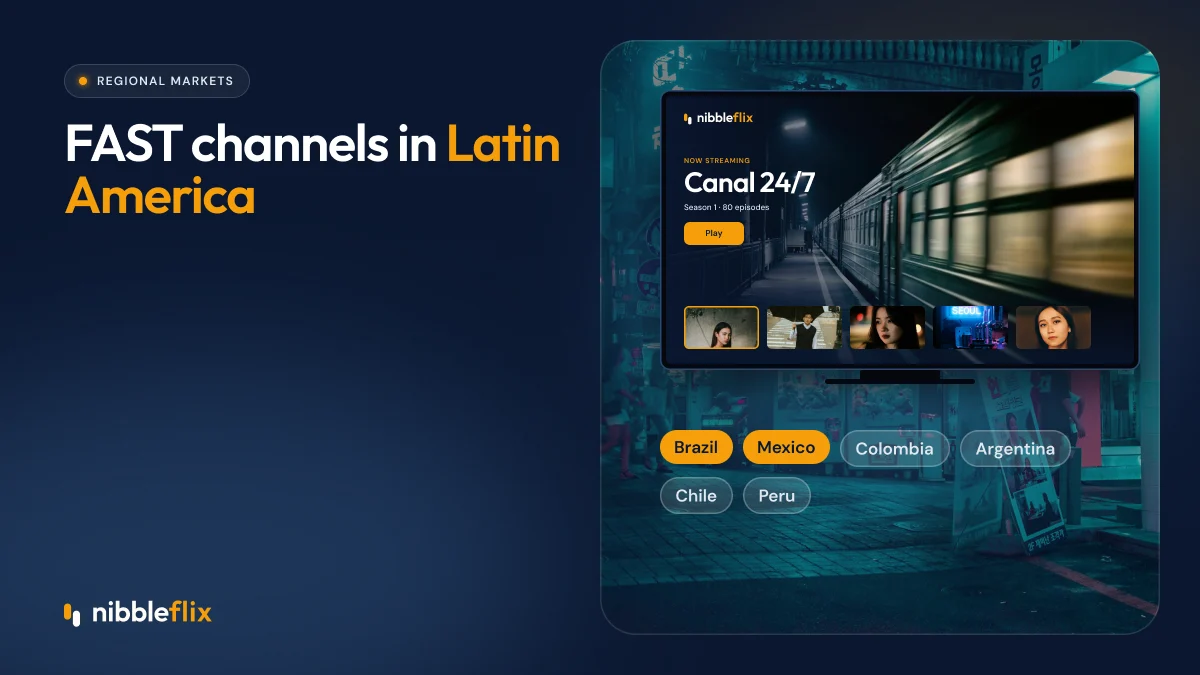
Mexico is the anchor for Spanish-language FAST in the region, and channels that work there can often extend to Colombia, Argentina, Chile and Peru with light changes.
- Language: Neutral Latin American Spanish is the safe default. Regional slang can feel local but may limit reach.
- Genres: Telenovelas, true crime, lucha libre and wrestling, music, comedy and family films.
- Cross-border reach: A Spanish FAST channel built for Mexico can also appeal to Spanish-speaking audiences in the US.
Spanish FAST channel vs Portuguese: planning the region
Treat Latin America as two linguistic markets that share many tastes. Here is a simple way to plan.
| Factor | Spanish-language channel | Portuguese-language channel |
|---|---|---|
| Core market | Mexico | Brazil |
| Extended reach | Colombia, Argentina, Chile, Peru and US Hispanic viewers | Mostly Brazil |
| Localization | Neutral Spanish dubbing or subtitles | Brazilian Portuguese dubbing preferred |
| Scheduling | Several time zones to balance | Fewer time zones, easier prime time |
| Forecast revenue (2027) | Mexico about US$93M | Brazil about US$100M |
What content works for free streaming TV in Latin America
The FAST channels Latin America viewers return to tend to share a few traits: a clear genre, recognizable faces or formats, and enough hours to avoid feeling repetitive. Good starting points include:
- Telenovela and drama channels, including dubbed Turkish and Korean series, which already have big followings.
- Comedy and stand-up channels in local language.
- Kids and animation channels, which travel easily between Spanish and Portuguese.
- Music, concert and urban culture channels.
- Documentary channels on nature, travel and true crime.
Short-form viewing is also exploding in the region. If you have serialized drama, read our piece on the micro-drama boom in Latin America to see how vertical formats can complement a FAST channel.
Launching FAST channels Latin America viewers will watch
- Confirm rights. Make sure you have linear, ad-supported rights for each country.
- Pick a language strategy. Decide whether you are launching Spanish, Portuguese or both, and budget for localization. AI dubbing can make dual-language channels affordable, with human review on key titles.
- Program for local prime time. Schedule your strongest content when families watch together in the evening.
- Set up ads. Use server-side ad insertion and look for regional ad partners to improve fill rates.
- Distribute on the right screens. Launch a branded app on popular smart TV platforms and Android TV devices, plus mobile for discovery.
- Promote locally. Use social clips and trailers in each language to drive tune-in.
Common mistakes to avoid
The biggest mistake is treating the region as one Spanish-speaking market and ignoring Brazil. The second is using machine translation for titles and descriptions without review, which can make a channel feel foreign. The third is running too many ads too early, which shortens viewing sessions before your audience is loyal.
A fourth mistake is ignoring the EPG. Viewers in the region often browse the guide the way they once flipped through broadcast channels, so clear titles and descriptions in the right language matter. Finally, do not launch and wait. Measure hours watched per channel each week, and move weaker shows out of prime time quickly.
Launching with NibbleFlix
NibbleFlix provides FAST channel tools with an EPG and server-side ad insertion, plus white-label apps for smart TVs, mobile and web. AI subtitles, AI dubbing and AI metadata help you build Spanish and Portuguese versions faster, and everything runs from one dashboard with no code required.
Key takeaways
- Latin American FAST revenue is forecast at US$207 million in 2027, led by Brazil and Mexico.
- Plan Spanish and Portuguese as separate channels with shared programming ideas.
- Telenovelas, kids, comedy, music and documentaries are strong starting genres.
- Local prime-time scheduling, quality localization and regional ad partners make the difference.
Ready to bring your library to Latin American TV screens? Book a demo and we will help you plan your channels.
Frequently asked questions
How big is the FAST market in Latin America?
Omdia forecasts Latin American FAST revenue of US$207 million in 2027. Brazil is expected to account for about US$100 million and Mexico for about US$93 million. Both rank among the top FAST markets outside the US, which makes them the natural first targets for content owners entering the region.
Should I launch in Spanish or Portuguese first?
It depends on your content and rights. Spanish gives you Mexico plus many other countries and US Hispanic viewers, while Portuguese gives you Brazil, the largest single market. Many owners start with whichever language their library already supports, then add the second using dubbing or subtitles.
What genres work best for FAST in Latin America?
Telenovelas and drama, comedy, kids and animation, music and documentaries are strong choices. Dubbed Turkish and Korean dramas also have large followings. The best channels pick one clear genre, carry enough hours to avoid repetition, and schedule their strongest titles for evening family viewing.
Do I need local ad partners in Latin America?
It helps. Global ad demand reaches the region, but local and regional partners often bring advertisers that want to reach specific countries or languages. Combining global demand with regional partners can improve fill rates and revenue, especially in the first months while your audience grows.