
In this article
- Why localization decides who wins in streaming
- How AI dubbing for streaming works
- What makes a good source file
- AI voice dubbing vs subtitles vs studio dubbing
- Spanish dubbing AI, Arabic and Portuguese: market notes
- Spanish
- Arabic
- Portuguese
- Quality control: where AI still needs people
- Rolling out AI dubbing on your streaming app
- Key takeaways
- Frequently asked questions
- Is AI dubbing good enough for paying subscribers?
- How long does AI dubbing take for one episode?
- Which languages should a streaming service dub first?
- Do I need permission to clone an actor’s voice?
Most streaming catalogs are recorded in one language, but growth now comes from viewers who speak another. AI dubbing for streaming lets you turn a single library into Spanish, Arabic and Portuguese versions in days instead of months, at a fraction of studio cost.
The short answer: AI dubbing for streaming uses speech recognition, machine translation and synthetic voices to produce a dubbed audio track that a human reviewer then checks before release. Done well, it lets a small team test new markets before committing to full studio dubs.
This guide covers how the process works, where AI voice dubbing fits next to subtitles and human studios, and how to roll it out across Latin America, the Middle East and beyond.
Why localization decides who wins in streaming
Viewers in growth regions want content in their own language, and many prefer listening to reading. Subtitles help, but dubbed audio is what turns a curious first view into a habit, especially on phones where people watch while commuting or cooking.
The demand is real. Sensor Tower reports that Latin America accounted for 23% of short drama app downloads in Q1 2026, with triple-digit year-on-year growth. In the Gulf and wider Arabic-speaking world, Omdia projected over 27 million SVOD subscriptions across MENA in 2025. Both audiences reward platforms that speak their language.
The problem has always been cost. Traditional studio dubbing for a full catalog in three languages can take a year and a budget most independent services do not have. That is the gap AI dubbing closes.
How AI dubbing for streaming works
Modern video localization AI chains several steps into one workflow. Each step can be reviewed and corrected, so you keep control over quality.
- Transcription. Speech recognition converts the original dialogue into a timed transcript.
- Translation. Machine translation produces a script in the target language, adapted to fit the timing of each line.
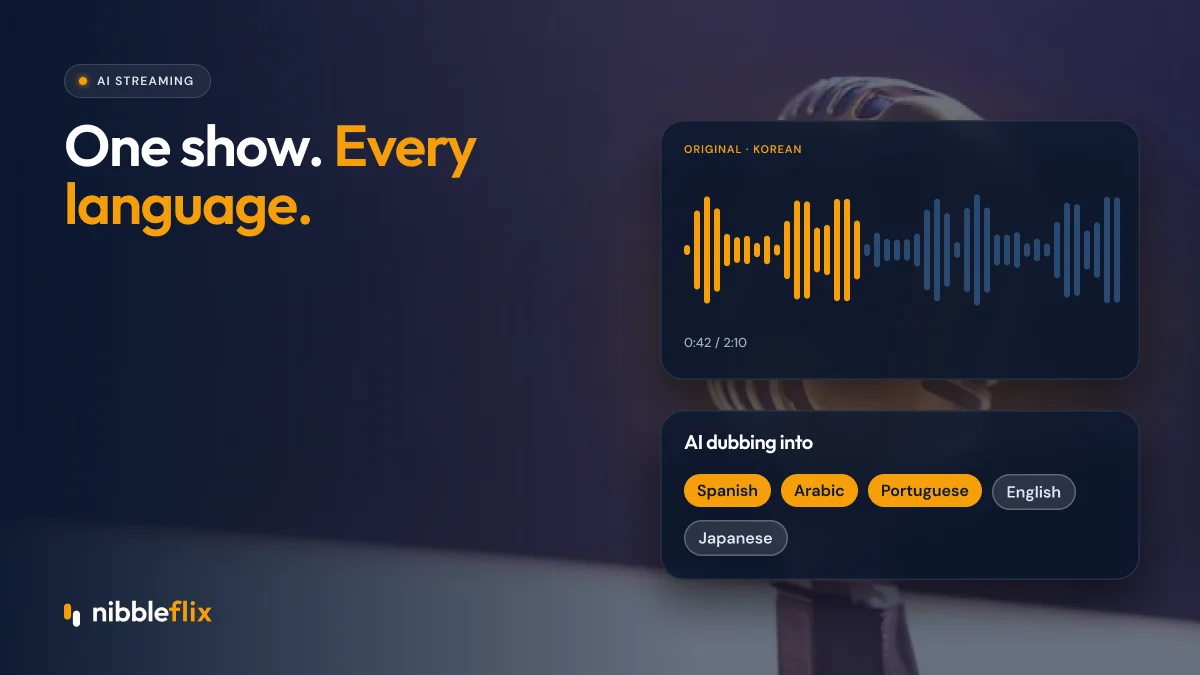
- Voice synthesis. AI voice dubbing generates speech, either from a library of stock voices or from a cloned voice that resembles the original actor (with consent).
- Timing and mixing. The new dialogue is aligned to scene cuts and mixed with the original music and effects track.
- Human review. A native speaker checks meaning, tone, names and cultural references before the track goes live.
The result is a separate audio track that viewers select in the player, just like any other language option.
What makes a good source file
Clean inputs give better dubs. If you have a separate music and effects stem, use it, because removing dialogue from a mixed track is harder. Accurate original subtitles also speed up transcription and reduce errors in names and slang.
AI voice dubbing vs subtitles vs studio dubbing
AI dubbing does not replace every other option. Most services use all three, matched to the title and the market.
| Option | Speed | Relative cost | Best for |
|---|---|---|---|
| AI subtitles | Hours | Lowest | Full catalog coverage, accessibility, fast tests |
| AI dubbing with human review | Days | Low to medium | Back catalog, micro-dramas, documentaries, new market tests |
| Studio dubbing | Weeks to months | Highest | Flagship originals, emotional drama, kids content |
A common pattern: subtitle everything, AI dub the titles with proven demand, and send only your biggest hits to a studio once revenue justifies it.
Spanish dubbing AI, Arabic and Portuguese: market notes
Each language has its own traps. Plan for them before you press publish.
Spanish
Spanish dubbing AI should target neutral Latin American Spanish for audiences from Mexico to Argentina, while Spain often expects Castilian voices and vocabulary. If Spain is a priority market, budget for two tracks rather than forcing one to serve both.
Arabic
When you dub content into Arabic, decide between Modern Standard Arabic and a regional dialect. Standard Arabic travels across the region, while Egyptian or Gulf dialects can feel warmer for comedy and drama. Check that your player and app interface also support right-to-left layouts, or the experience will feel half-finished.
Portuguese
Brazilian Portuguese and European Portuguese differ in accent and vocabulary. Brazil is the larger streaming market, so most services start there and add a European track later if Portugal performs.
Quality control: where AI still needs people
AI handles volume. People handle judgment. Build a light review step into every release so mistakes never reach viewers.
- Check character names, brand names and place names for correct pronunciation.
- Review jokes, idioms and insults, which rarely translate word for word.
- Listen for emotional flatness in key scenes and re-generate lines where needed.
- Confirm lip-sync is acceptable for close-ups; wide shots are more forgiving.
- Get written consent before cloning any actor’s voice, and keep records.
One reviewer per language can usually check several hours of content a day, which keeps the process fast without cutting corners.
Rolling out AI dubbing on your streaming app
Start small and let data guide you. Pick ten to twenty titles that already perform well in your original language, dub them into one new language, and promote them to that region. Track completion rates and watch time per language before expanding.
On NibbleFlix, AI dubbing sits alongside AI subtitles in 12 languages, AI metadata generation and AI trailer generation, all managed from the same admin dashboard and CMS. You upload an episode once, generate the language tracks, review them and schedule the release without writing code. See the full toolset on our AI streaming solution page.
For micro-drama catalogs, where a single series can have 60 to 100 short episodes, this workflow is especially useful. Our guide to micro-drama in Latin America explains why Spanish and Portuguese versions matter there, and five AI tools every streaming service should use covers the wider AI stack.
Key takeaways
- AI dubbing for streaming cuts localization time from months to days and makes new markets testable.
- Combine AI subtitles, AI dubbing and studio dubbing based on each title’s proven demand.
- Plan for regional variants: Latin American vs Castilian Spanish, Standard vs dialect Arabic, Brazilian vs European Portuguese.
- Keep a native-speaker review step and get consent for any voice cloning.
- Expand languages based on completion rates and watch time, not guesswork.
Want to see AI dubbing, subtitles and trailers working inside a white-label app with your brand on it? Book a demo and we will walk you through the workflow.
Frequently asked questions
Is AI dubbing good enough for paying subscribers?
For most back catalog, documentaries and micro-dramas, yes, provided a native speaker reviews each track before release. Flagship originals with heavy emotional scenes may still deserve studio dubbing. Many services use AI dubbing to test demand, then upgrade the biggest hits to studio versions.
How long does AI dubbing take for one episode?
Generation itself is fast, often minutes per episode. The real time goes into review and fixes, which depends on dialogue density and language. A practical plan is a few days for a short series in one new language, including a full listening pass by a native speaker.
Which languages should a streaming service dub first?
Start where your data shows demand. For many global catalogs that means Latin American Spanish, Brazilian Portuguese and Arabic, because those audiences are large and prefer audio over subtitles. Test ten to twenty proven titles first, then expand based on completion rates and watch time.
Do I need permission to clone an actor’s voice?
Yes. Get written consent from the performer before creating a synthetic version of their voice, and check your talent and union agreements. If consent is not available, use a stock AI voice instead. Keep records of every agreement so you can show them to partners or regulators.