
In this article
- How server-side ad insertion works
- Client-side vs server-side ads
- Why SSAI matters for streaming businesses
- A TV-quality viewing experience
- Ad blocking in streaming
- One integration for many devices
- Where SSAI fits: FAST, AVOD and live
- What to check before switching on server-side ad insertion
- How NibbleFlix handles SSAI
- Key takeaways
- Frequently asked questions
- What is SSAI in streaming?
- Is SSAI the same as dynamic ad insertion?
- Can ad blockers block SSAI ads?
- Do I need SSAI for a FAST channel?
If you run ads on a streaming service, how those ads reach the screen matters as much as who buys them. Server-side ad insertion is the method most FAST channels and many AVOD services use to deliver ads that play smoothly on phones, browsers and smart TVs.
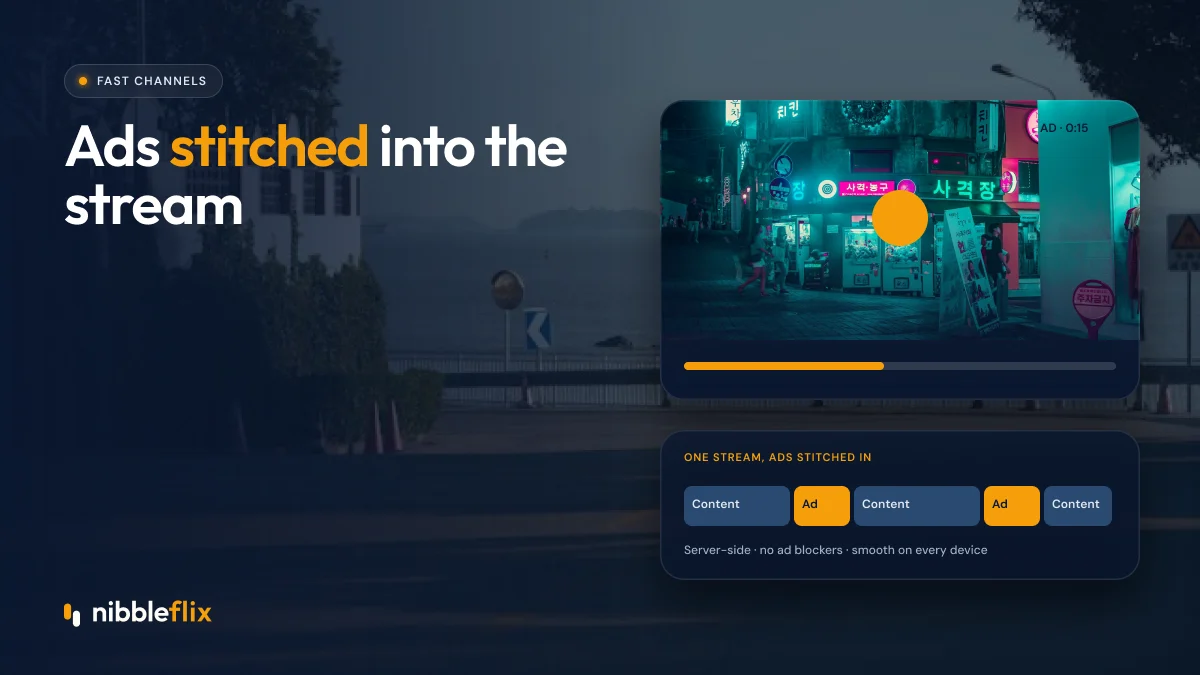
Server-side ad insertion (SSAI) means ads are stitched into the video stream on a server before it reaches the viewer, so content and ads arrive as one continuous stream instead of being loaded separately by the player.
This guide explains how SSAI works, how it compares with client-side ads, and what to check before you switch it on.
How server-side ad insertion works
Modern streaming video is delivered in short segments, usually a few seconds each, listed in a manifest file. With SSAI, a server sits between your video origin and the viewer. When a player requests the manifest, the server builds a personalized version for that viewer.
- The player requests the stream. It asks for the manifest as usual.
- The SSAI server spots an ad break. Ad markers in the content tell it where breaks belong.
- It calls the ad server. The ad server picks ads for that viewer based on targeting data.
- It stitches the ads in. Ad segments, already transcoded to match the content, are inserted into the manifest.
- The player plays one stream. Content and ads flow together, and tracking beacons report impressions.
This approach is often called dynamic ad insertion, because each viewer can get different ads even when watching the same program at the same time.
Client-side vs server-side ads
The alternative is client-side ad insertion (CSAI). Here the player pauses content, fetches an ad from the ad server, plays it in a separate player instance, then resumes. It is simpler to set up and gives rich interactivity, but it depends heavily on the device.
| Factor | Server-side (SSAI) | Client-side (CSAI) |
|---|---|---|
| Playback | One continuous stream, no buffering at breaks | Player switches between content and ads |
| Ad blockers | Harder to block, ads are part of the stream | Easier to block ad calls |
| Smart TV support | Works on almost any device that plays video | Needs ad SDKs per platform |
| Live and linear | Well suited to FAST and live streams | Harder to time on linear channels |
| Interactivity | Limited clickable or interactive formats | Supports interactive and clickable ads |
| Measurement | Needs server-side or hybrid beacons | Player tracks directly |
For most streaming businesses targeting connected TVs, SSAI is the default choice. CSAI still has a place in web and mobile apps where interactive ad formats matter.
Why SSAI matters for streaming businesses
A TV-quality viewing experience
Viewers notice when an ad break stutters, buffers or shows a black screen. SSAI removes that jolt because the ad is already part of the stream. That matters most on living room TVs, where viewers expect broadcast-style smoothness.
Ad blocking in streaming
Ad blockers mostly work by stopping requests to known ad servers. With SSAI, ads come from the same source as the content, so they are much harder to strip out. For ad-funded services, that protects revenue directly.
One integration for many devices
Smart TV platforms such as Roku, Samsung, LG and Fire TV each have their own quirks. SSAI reduces the need to integrate an ad SDK on every one, because the player only needs to play video.
Where SSAI fits: FAST, AVOD and live
SSAI is close to essential for FAST channels. A 24/7 linear stream has scheduled breaks, and every viewer watching at that moment hits the same break, so stitching ads on the server is the practical way to fill them. If you are weighing models, see FAST vs AVOD.
For on-demand AVOD, SSAI handles pre-rolls and mid-rolls in a way that plays smoothly across devices. It also fits hybrid apps, where some viewers watch free with ads and others pay to remove them. Our guide to how FAST channels make money covers CPMs, fill rate and ad sales in more depth.
The ad-supported market gives SSAI real weight. Omdia, as reported by Digital TV Europe, forecasts global FAST revenue of US$12 billion in 2027, and every dollar of it depends on ads being delivered reliably.
What to check before switching on server-side ad insertion
- Ad markers. Your content needs clean break markers. On linear channels these come from your schedule and EPG; on VOD you set cue points per title.
- Ad transcoding. Ads must match your stream’s resolution and bitrate ladder, or quality will jump at each break.
- Measurement. Buyers want verified impressions. Confirm how beacons fire and which standards are supported.
- Ad load rules. Decide how many minutes of ads per hour fit your audience. Too many will hurt watch time.
- Privacy and consent. In Europe, GDPR consent rules apply to targeted ads. Make sure consent signals reach the ad server.
- Regional demand. Ad demand varies by market. A channel in Germany, Brazil or Saudi Arabia may need local ad partners to keep fill rates healthy.
How NibbleFlix handles SSAI
NibbleFlix includes server-side ad insertion as part of its FAST channel tools, alongside an EPG for scheduling. For on-demand apps, you can combine ads with subscriptions, rentals or coins through hybrid monetization, so viewers can watch free with ads or pay to skip them. Your branded apps run across iOS, Android, web and smart TVs, all managed from one dashboard with no code.
Key takeaways
- SSAI stitches ads into the stream on a server, so ads and content play as one.
- It gives smoother playback, stronger resistance to ad blockers and simpler smart TV support.
- It is the standard for FAST channels and a strong fit for AVOD and hybrid apps.
- Check ad markers, transcoding, measurement, ad load and consent before you launch.
Want to see SSAI working on a channel built from your own content? Book a demo and we will show you how it fits your plans.
Frequently asked questions
What is SSAI in streaming?
SSAI stands for server-side ad insertion. It is a method where ads are stitched into the video stream on a server before delivery, so the viewer’s player receives one continuous stream. This avoids buffering at ad breaks, makes ads harder to block, and works on almost any device that can play video.
Is SSAI the same as dynamic ad insertion?
The terms overlap. Dynamic ad insertion means choosing ads per viewer at the moment of playback rather than burning them into the file. SSAI is one way to do that, on the server. Client-side insertion can also be dynamic, but the player fetches the ads itself instead of receiving them already stitched in.
Can ad blockers block SSAI ads?
It is much harder. Most ad blockers work by blocking requests to known ad domains. With SSAI the ads arrive in the same stream and from the same source as the content, so blocking them would usually block the video too. This makes SSAI attractive for services that rely on ad revenue.
Do I need SSAI for a FAST channel?
In practice, yes. FAST channels run continuous linear streams with scheduled breaks, and they are watched mostly on smart TVs. Server-side insertion is the most reliable way to fill those breaks with targeted ads across many devices, and many FAST distribution partners expect channels to support it.