
In this article
- FAST vs AVOD: the core difference
- What FAST looks like to a viewer
- What AVOD looks like to a viewer
- FAST channels vs AVOD side by side
- How the money works in each model
- Free ad-supported TV: when FAST is the better fit
- Linear streaming vs on-demand: when AVOD is the better fit
- Should you launch FAST, AVOD or both?
- A simple decision path
- Regional examples
- How NibbleFlix supports both models
- Key takeaways
- Frequently asked questions
- Is FAST the same as AVOD?
- Which earns more, FAST or AVOD?
- How much content do I need for a FAST channel?
- Can I run FAST and AVOD in the same app?
If you own a video library and want to earn from it without charging viewers, you will quickly hit the FAST vs AVOD question. Both models are free to watch and paid for by advertising, so they often get lumped together. In practice they suit different content, different viewing habits and different distribution plans.
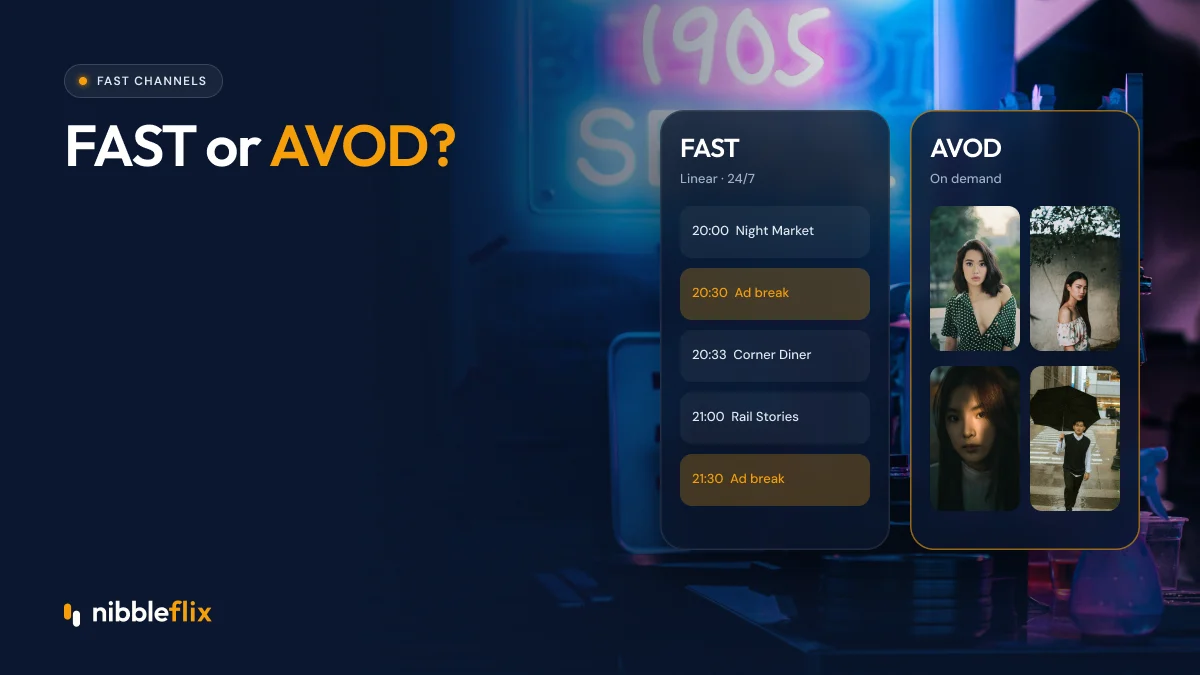
The short answer: FAST (free ad-supported streaming TV) delivers scheduled linear channels that viewers drop into like broadcast TV, while AVOD (advertising video on demand) lets viewers pick any title from a library and watch it whenever they want, with ads inserted.
This guide explains how each one works, where the money comes from, and how to decide which to launch first, or whether to run both.
FAST vs AVOD: the core difference
The difference comes down to who controls the schedule. On a FAST channel, you program a 24/7 stream. The viewer tunes in and sees whatever is playing now, just like cable TV. On an AVOD service, the viewer browses a catalog, chooses an episode or film, and starts it from the beginning.
That single difference shapes everything else: how you package content, how ads are sold, which devices matter most, and how much effort your team puts into programming versus merchandising.
What FAST looks like to a viewer
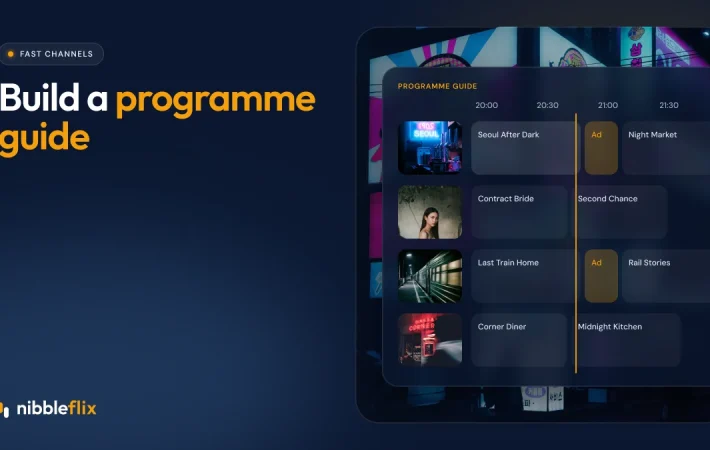
A FAST viewer opens an app or a smart TV channel guide, scrolls through a grid of channels, and lands on one. There is no decision about what to watch next. The channel keeps going, which makes it ideal for lean-back viewing, background viewing and long sessions on the living room TV.
What AVOD looks like to a viewer
An AVOD viewer behaves more like a Netflix user. They search, browse rows, pick a title and binge. Sessions are driven by intent. That suits series with strong story arcs, films, and niche libraries where people arrive looking for something specific.
FAST channels vs AVOD side by side
Here is how the two models compare on the points that matter most to a content owner.
| Factor | FAST | AVOD |
|---|---|---|
| Viewing style | Linear, scheduled, lean-back | On-demand, viewer chooses |
| Main screen | Connected TV | Mobile, web and TV |
| Content needs | Enough hours to fill a 24/7 schedule with loops | A browsable catalog with good metadata |
| Key tooling | Electronic program guide (EPG), playout, SSAI | CMS, search, recommendations, ad insertion |
| Ad breaks | Scheduled breaks, like broadcast | Pre-roll and mid-roll per title |
| Distribution | Own app plus third-party FAST platforms | Mostly your own apps |
| Best for | Genre libraries, reruns, news, music, kids | Series, films, niche and community content |
How the money works in each model
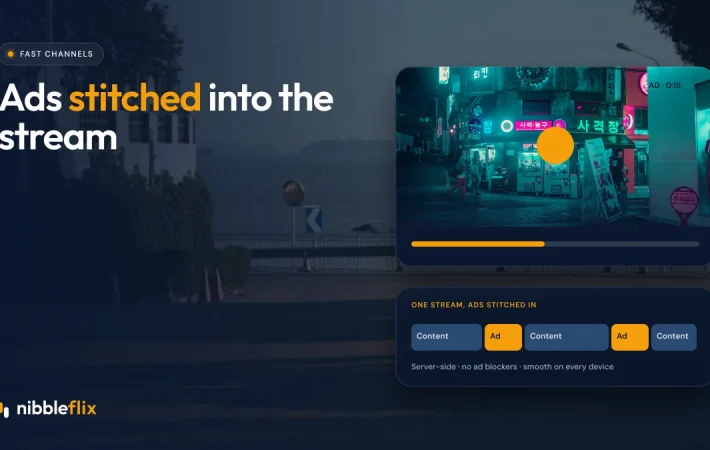
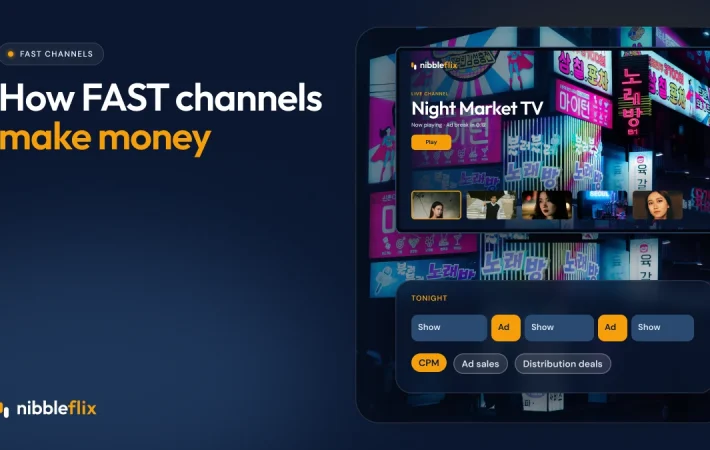
Both models earn from ads, but the mechanics differ. A FAST channel sells ad breaks within a continuous stream, usually through server-side ad insertion so ads are stitched into the video and play smoothly on any TV. Revenue depends on hours watched, fill rate and CPM.
AVOD revenue follows the same basic formula, but ad load is tied to each title a viewer starts. You can tune pre-rolls and mid-rolls per show, and you can mix AVOD with other models in the same app, for example a free tier with ads plus a paid ad-free subscription. Our guide to SVOD, AVOD, TVOD and hybrid monetization covers these combinations.
The FAST market is sizeable. Omdia forecasts reported by Digital TV Europe put global FAST revenue at US$12 billion in 2027, with the US taking over 80% of it. In Europe, valantic and FUNKE research reported by Señal News estimate FAST revenue at €1.34 billion in 2025, rising to a forecast €3.04 billion in 2030.
Free ad-supported TV: when FAST is the better fit
FAST tends to win when your content works without the viewer actively choosing each piece. Good signs that you should start with a FAST channel include:
- You have hundreds of hours of similar content, such as cooking, travel, documentaries, classic series or sport highlights.
- Your audience watches mostly on connected TVs.
- You want reach on third-party FAST platforms, not only in your own app.
- You are comfortable selling advertising by the hour rather than by the title.
For a deeper walkthrough, read what a FAST channel is and how to launch one.
Linear streaming vs on-demand: when AVOD is the better fit
AVOD is the stronger choice when viewers come to you for specific titles. It also suits mobile-first audiences, which matters in markets like Latin America and Southeast Asia, where a lot of viewing happens on phones.
- Your library is made of distinct series or films with loyal fans.
- You want to upsell viewers to a subscription, rentals or coins later.
- You care about building first-party viewer data and a direct relationship.
- Your content is episodic and people binge it in order.
Should you launch FAST, AVOD or both?
For many content owners the honest answer to FAST vs AVOD is “both, in sequence”. The two models feed each other. A FAST channel introduces viewers to your shows; an AVOD library lets the curious ones go back and watch from episode one.
A simple decision path
- Audit your library. Count hours, check rights for ad-supported and linear use, and group titles by genre.
- Pick your lead screen. TV-heavy audiences point to FAST first; mobile-heavy audiences point to AVOD first.
- Launch one model well. Get ads, metadata and playback right before adding a second model.
- Add the other model. Use the same library and the same dashboard to extend reach.
Regional examples
A UK documentary producer with a deep back catalog might start with a FAST channel for smart TVs and add AVOD later. A Mexican telenovela studio might start with an AVOD app on phones, then spin out a themed FAST channel once the brand is known. A Korean drama distributor targeting Southeast Asia could run both from day one, using AVOD for new titles and FAST for older seasons.
How NibbleFlix supports both models
NibbleFlix lets you run FAST channels and on-demand apps from one platform under your own brand. For FAST, you get FAST channel tools including an EPG and server-side ad insertion. For AVOD, you can combine ads with subscriptions, rentals or coins through flexible monetization options.
Your apps run on iOS, Android, web and smart TVs including Roku, Fire TV, Samsung and LG, and you manage everything from one admin dashboard with no code required.
Key takeaways
- FAST is linear and lean-back; AVOD is on-demand and intent-driven.
- Both earn from ads, but FAST sells breaks in a stream while AVOD sells breaks around each title.
- FAST suits large, similar libraries and TV audiences; AVOD suits series, films and mobile viewers.
- Many owners launch one model first, then add the other using the same library.
Not sure which model fits your library? Book a demo and we will walk through FAST and AVOD options for your content.
Frequently asked questions
Is FAST the same as AVOD?
No. Both are free for viewers and funded by ads, but FAST delivers scheduled linear channels that play continuously, while AVOD lets viewers pick individual titles from a library and watch on demand. FAST is closer to broadcast TV; AVOD is closer to a Netflix-style catalog with ads instead of a subscription fee.
Which earns more, FAST or AVOD?
It depends on your content and audience. FAST can generate long viewing sessions on TVs, which means many ad impressions per viewer. AVOD can earn more per engaged fan and lets you add subscriptions or rentals. Many content owners run both and compare results by hours watched and revenue per viewer.
How much content do I need for a FAST channel?
You need enough hours to fill a 24/7 schedule without repeating too often. Many channels start with a few hundred hours and use rotation and themed blocks to stretch the library. Genre focus matters more than volume, because viewers expect a consistent channel identity every time they tune in.
Can I run FAST and AVOD in the same app?
Yes. Many services offer live linear channels alongside an on-demand library, so viewers can drop into a channel or browse titles in one place. With NibbleFlix you can manage FAST channels and on-demand content from one dashboard and apply different monetization rules to each.