
In this article
- Why founders underestimate micro drama app development cost
- The real cost components of a short drama app
- 1. Product and engineering
- 2. Video infrastructure
- 3. Monetization stack
- 4. Content
- 5. Marketing and user acquisition
- 6. Maintenance
- Build vs white label micro drama app price comparison
- What a white-label short drama app cost includes
- Hidden costs most budgets miss
- How to budget for your first year
- Key takeaways
- Frequently asked questions
- How much does it cost to build an app like ReelShort?
- Is a white label micro drama app cheaper than custom development?
- What is the biggest cost in running a short drama app?
- Do app store fees affect micro drama app revenue?
The micro drama app development cost you see in agency quotes is usually only part of the story. The build is one line item; the player, payments, content, store fees and years of maintenance are the rest.
Short answer: micro drama app development cost depends mostly on whether you build in-house or launch on a white-label platform. Custom builds require a full engineering team and ongoing maintenance, while a white-label platform turns most of that into a predictable subscription so your budget can go to content and marketing.
This guide breaks down every cost you should plan for, so you can compare quotes honestly and avoid surprises after launch.
Why founders underestimate micro drama app development cost
A short drama app looks simple: a vertical video feed and a coin store. Under the surface, it needs a smooth 9:16 player that preloads the next episode, secure video delivery, an unlock system tied to Apple and Google in-app purchases, an ad SDK for rewarded unlocks, a content management system, analytics and push notifications.
Each of those is a project. Together they explain why the cost to build an app like ReelShort is far higher than a typical content app. And because the leaders are large, the bar is high: Sensor Tower reports that DramaBox and ReelShort each grossed close to US$140 million in Q1 2026, so viewers expect a polished experience from day one.
The real cost components of a short drama app
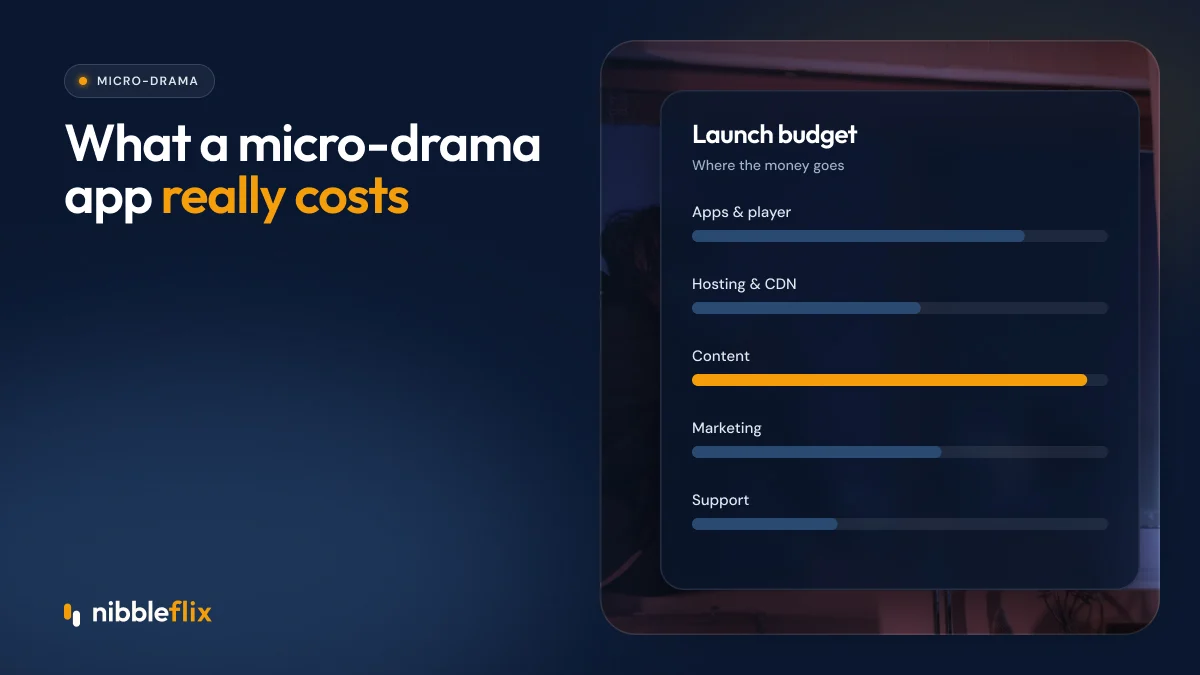
Whatever route you choose, these are the budget lines to plan for.
1. Product and engineering
iOS, Android and web apps, plus a backend for users, entitlements and coins. If you build, you need mobile, backend and video engineers, a designer and QA. If you buy, this becomes a platform fee.
2. Video infrastructure
Encoding, storage and content delivery. Short episodes add up: a catalog of 40 series with 80 episodes each is 3,200 files to encode, store and stream, often in several resolutions.
3. Monetization stack
Coin packs, VIP passes, pay-per-episode, rewarded ads and promotional offers. Each must work with App Store and Google Play billing rules. Apple and Google take a commission of up to 30% on in-app purchases, which affects your margin on every coin pack.
4. Content
Often the largest line item. Licensing, commissioning or co-producing vertical series, plus subtitles and dubbing for each target language.
5. Marketing and user acquisition
Short drama apps grow through paid social and performance ads featuring hook scenes. Plan for this from day one.
6. Maintenance
New OS versions, store policy changes, SDK updates and bug fixes never stop. In-house teams often spend a large share of their time just keeping the app current.
Build vs white label micro drama app price comparison
Here is how the two main routes compare across the factors that drive cost.
| Cost factor | Custom build | White-label platform |
|---|---|---|
| Upfront development | High: full team for many months | Low: setup and configuration |
| Time to revenue | Many months | Days to weeks |
| Vertical 9:16 player | Built and tuned by your team | Included |
| Coins, VIP, ad unlocks | Custom integration work | Configured in a dashboard |
| Smart TV and web apps | Extra projects per platform | Included on many platforms |
| Ongoing maintenance | Your team, indefinitely | Handled by the platform |
| Ownership of brand and data | Full | Full, if truly white-label |
The custom route makes sense if your product is the technology itself. For most studios, broadcasters and content owners, the product is the stories, and every month spent building is a month without revenue. Our guide to white-label OTT platforms explains what to look for.
What a white-label short drama app cost includes
When you compare platforms, check exactly what the fee covers. With NibbleFlix micro-drama apps, the package includes:
- iOS, Android, responsive web and PWA apps, with smart TV apps for Apple TV, Android TV, Amazon Fire TV, Roku, Samsung and LG.
- A vertical 9:16 player with swipe navigation.
- Monetization through coins, pay-per-episode, VIP passes, subscriptions, ads, rentals and promotional offers, alone or combined.
- A CMS and admin dashboard to upload episodes, set prices, schedule releases and see earnings without code.
- Retention tools such as daily check-in rewards and new-episode push alerts.
- AI subtitles in 12 languages, AI dubbing, AI metadata and AI trailer generation.
- Launch support, with store listings under your own name.
Watch for hidden extras with other vendors: per-platform fees for TV apps, revenue share on top of a license fee, or charges for each new language.
Hidden costs most budgets miss
- Store commission: price coin packs so your margin survives the store cut. For example, on a US$4.99 coin pack, a 30% commission leaves about US$3.49 before taxes.
- Localization: subtitles and dubbing per market. AI tools reduce this, but budget for human review.
- Payments and tax: VAT in Europe and local tax rules in markets such as Brazil or Saudi Arabia.
- Data privacy: GDPR compliance if you serve viewers in the EU.
- Content refresh: viewers expect new series every week, not every quarter.
How to budget for your first year
A practical approach is to split your first-year budget into three buckets: platform, content and growth. If you launch on a white-label platform, the platform bucket becomes small and predictable, so most of your money can go to series that viewers will pay for and the ads that bring them in.
The NibbleFlix founding partner program also locks launch pricing for the first year, adds a dedicated launch manager and prioritizes your feature requests on the roadmap. See current plans on our pricing page.
Key takeaways
- Micro drama app development cost covers far more than the initial build.
- Content, user acquisition and maintenance often outweigh development.
- Store commission of up to 30% must be priced into every coin pack.
- A white-label platform converts engineering cost into a predictable fee and speeds up time to revenue.
- Always check what a platform fee includes: TV apps, languages and revenue share.
Want a clear picture of what your launch would cost? Book a demo and we will walk through a plan for your catalog and markets.
Frequently asked questions
How much does it cost to build an app like ReelShort?
A custom build needs mobile, backend and video engineers, a designer and QA for many months, plus ongoing maintenance, so it is a large investment before any revenue. A white-label platform replaces most of that with a predictable fee, letting you spend your budget on content and user acquisition instead of engineering.
Is a white label micro drama app cheaper than custom development?
For most content owners, yes. You avoid hiring an engineering team and paying for months of development, and maintenance is handled by the platform. You still own your brand, store listings, viewer data and revenue, so the trade-off is mainly control over low-level code you probably do not need.
What is the biggest cost in running a short drama app?
For most operators it is content, followed by user acquisition. Licensing or producing enough vertical series and buying ads to promote them usually outweighs platform costs. That is why many founders keep technology spend predictable with a white-label platform and put the rest into stories and marketing.
Do app store fees affect micro drama app revenue?
Yes. Apple and Google charge a commission of up to 30% on in-app purchases such as coin packs and VIP passes. Build that cut into your pricing from the start, and consider offering rewarded ad unlocks and web payments where store rules allow to diversify revenue.