
In this article
- SVOD, AVOD, TVOD: streaming monetization models at a glance
- What is SVOD?
- SVOD pros and cons
- What is AVOD?
- AVOD pros and cons
- What is TVOD?
- TVOD pros and cons
- Hybrid monetization: combining SVOD, AVOD, TVOD
- How to choose the right model
- Setting up monetization without code
- Key takeaways
- Frequently asked questions
- What is the difference between SVOD, AVOD and TVOD?
- Which streaming monetization model makes the most money?
- Can I switch monetization models after launch?
- Do app stores take a cut of streaming subscriptions?
Every streaming service has to answer one question early: how will viewers pay? The SVOD AVOD TVOD choice shapes your pricing, your content plan, your marketing and even the devices you prioritize.
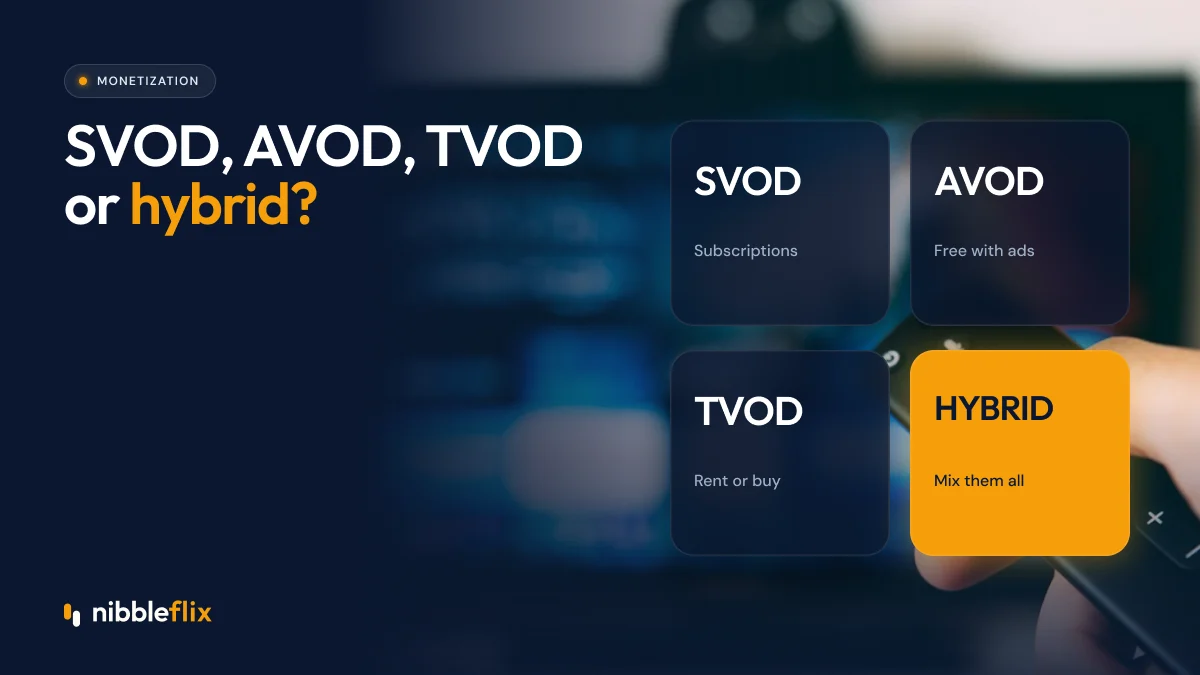
The direct answer: SVOD charges a recurring subscription, AVOD is free to watch and earns from ads, TVOD charges per title through rentals or purchases, and hybrid combines two or more of these in one app.
This guide explains each of the streaming monetization models, when each works, and how to combine them without confusing your viewers.
SVOD, AVOD, TVOD: streaming monetization models at a glance
| Model | How viewers pay | Best for | Main risk |
|---|---|---|---|
| SVOD | Monthly or annual subscription | Deep catalogs, niche fans, regular releases | Churn when new content slows |
| AVOD | Free, watch ads | Large audiences, price-sensitive markets | Needs scale to earn well |
| TVOD | Rent or buy per title | Premieres, films, live events, courses | Revenue spikes and dips |
| Hybrid | Mix of the above | Most growing services | Complex pricing if poorly designed |
What is SVOD?
SVOD (subscription video on demand) gives viewers unlimited access to a library for a recurring fee. It is the model most people associate with streaming, and it produces predictable monthly revenue you can plan around.
SVOD works when viewers believe there will always be something new worth watching. That means a release calendar, a clear niche, or both. A faith channel, a martial arts library or a Korean drama service can all run on SVOD because their fans know what they are paying for.
Demand is real in growth regions too. Omdia projects more than 27 million SVOD subscriptions in MENA in 2025, which shows subscription habits are spreading well beyond the US and Western Europe.
SVOD pros and cons
- Pro: predictable recurring revenue and clear customer lifetime value.
- Pro: no ads, which suits premium and kids content.
- Con: you must keep adding content to justify the fee.
- Con: app store commission of up to 30% applies to in-app subscriptions on iOS and Android, so factor it into pricing.
What is AVOD?
AVOD (advertising video on demand) lets anyone watch for free in exchange for ads. You earn per thousand ad impressions, so revenue grows with audience size and watch time.
Viewers are often happy with this trade. According to the valantic and FUNKE State of TV and Video 2026 study, 71% of connected-TV users in the DACH region accept ads in exchange for free content. AVOD also lowers the barrier to trying your app, which helps in price-sensitive markets across Latin America and Southeast Asia.
AVOD pros and cons
- Pro: no payment friction, so audiences grow faster.
- Pro: works well for older catalog titles that would not sell a subscription alone.
- Con: you need significant scale and watch time to earn meaningful revenue.
- Con: ad experience must be managed so it does not drive viewers away.
If you run linear, always-on channels, AVOD connects closely to FAST. See what a FAST channel is and how to launch one.
What is TVOD?
TVOD (transactional video on demand) charges per title. Viewers either rent for a time window, often 48 hours, or buy to own. Pay-per-view live events and pay-per-episode micro-dramas are close cousins of TVOD.
TVOD fits content that people want badly but only once: a film premiere, a concert, a stand-up special, a sports fight or a training course. It also lets you charge a premium for new releases before they move into a subscription or ad tier.
TVOD pros and cons
- Pro: high revenue per title for strong releases.
- Pro: no ongoing commitment needed from viewers.
- Con: revenue is uneven and depends on your release schedule.
- Con: each title needs its own marketing push.
Hybrid monetization: combining SVOD, AVOD, TVOD
Most growing services now run hybrid models. The idea is simple: give each type of viewer a way to pay that suits them, rather than forcing everyone into one plan.
Common hybrid setups include:
- Free plus premium: an AVOD tier with ads and an SVOD tier without them.
- Subscription plus premieres: SVOD for the library, TVOD for new films or live events.
- Freemium micro-drama: first episodes free, then unlock by coins, a VIP pass or watching an ad.
- Subscription plus promotions: discounted first months or annual plans to cut churn.
The key is clarity. Each tier should have an obvious reason to exist, and viewers should understand within seconds what they get for free and what costs money. Our guide to hybrid monetization for streaming covers tier design in more detail.
How to choose the right model
Use these questions to narrow the SVOD, AVOD, TVOD choice:
- How big is your catalog? Small and premium suggests TVOD. Large and steady suggests SVOD or AVOD.
- How often do you release? Weekly releases support SVOD. Occasional big releases suit TVOD.
- Where are your viewers? Price-sensitive mobile markets often start with AVOD or micro-payments. Markets with strong card usage support subscriptions.
- How large is your audience? AVOD needs scale. A small loyal community usually earns more through SVOD.
You do not have to get it perfect at launch. Start with the model that best fits your content, measure conversion and churn, then add a second model once you understand your viewers.
Setting up monetization without code
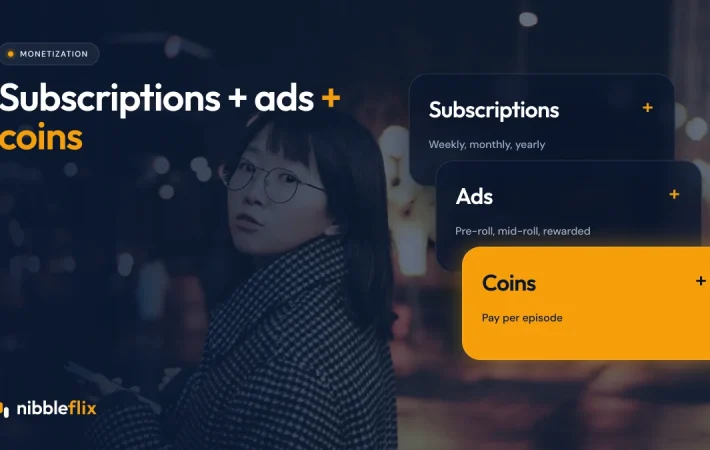
On NibbleFlix, subscriptions, advertising, rentals, pay-per-episode, coins, in-app purchases and promotional offers are all built in, and you can combine several in one app. You set prices and tiers from the admin dashboard and CMS without writing code, and see earnings in the same place.
Explore all the options on the monetization page, or see how they apply to a long-form service on the entertainment OTT solution page.
Key takeaways
- SVOD earns recurring revenue but needs steady content to limit churn.
- AVOD removes payment friction and grows audiences, but needs scale.
- TVOD earns the most per title for premieres, events and films.
- Hybrid models let each viewer pay their way and are now the norm.
- Start with one model that fits your content, then add more based on data.
Want help designing tiers for your catalog? Book a demo and we will show you how each model works inside your own branded app.
Frequently asked questions
What is the difference between SVOD, AVOD and TVOD?
SVOD charges a recurring subscription for unlimited access. AVOD is free to watch and earns money from ads. TVOD charges per title through rentals or purchases. Each suits different content and audiences, and many services combine them in a hybrid model so viewers can choose how they pay.
Which streaming monetization model makes the most money?
There is no single winner. SVOD gives predictable revenue for services with steady releases, AVOD earns well with large audiences, and TVOD earns the most per title for premieres and events. Hybrid models often perform best because they capture revenue from paying viewers and from those who will only watch free.
Can I switch monetization models after launch?
Yes. Many services launch with one model and add others once they understand viewer behavior. On a platform with built-in monetization, you can add an ad tier, rentals or promotions from the dashboard without rebuilding your app. Communicate changes clearly to existing subscribers to avoid confusion or churn.
Do app stores take a cut of streaming subscriptions?
Apple and Google charge a commission of up to 30% on in-app purchases and subscriptions sold inside their apps, with lower rates in some cases. Factor this into your pricing, and check current store rules for your markets, since terms and exceptions change over time.