
In this article
- Finding the best OTT platform provider starts with your needs
- Ownership and control: questions 1 to 3
- 1. Will the apps be published under my name?
- 2. Who owns the viewer data?
- 3. Who collects the revenue?
- Product fit: questions 4 to 7
- 4. Which devices are covered out of the box?
- 5. Which monetization models can I combine?
- 6. Does it support my format?
- 7. What AI and localization tools are included?
- Launch and operations: questions 8 to 10
- 8. How long until my apps are in the stores?
- 9. Can my team run it without developers?
- 10. What support do I get at launch and after?
- Commercial and risk: questions 11 and 12
- 11. How is pricing structured as I grow?
- 12. Can I migrate in, and out?
- OTT vendor comparison scorecard
- Red flags when you choose a streaming platform
- Comparing white label OTT vendors
- Key takeaways
- Frequently asked questions
- How do I find the best OTT platform provider for my business?
- What is a white-label OTT vendor?
- How long should an OTT platform evaluation take?
- Should I choose a vendor with the most features?
Picking a streaming vendor is one of the few decisions that is expensive to undo. The best OTT platform provider for you is not the one with the longest feature list, but the one that fits your content, your markets and your team.
The direct answer: the best OTT platform provider is the one that gives you full ownership of your brand, data and revenue, covers the devices and monetization models you need, and can get you live quickly with real support.
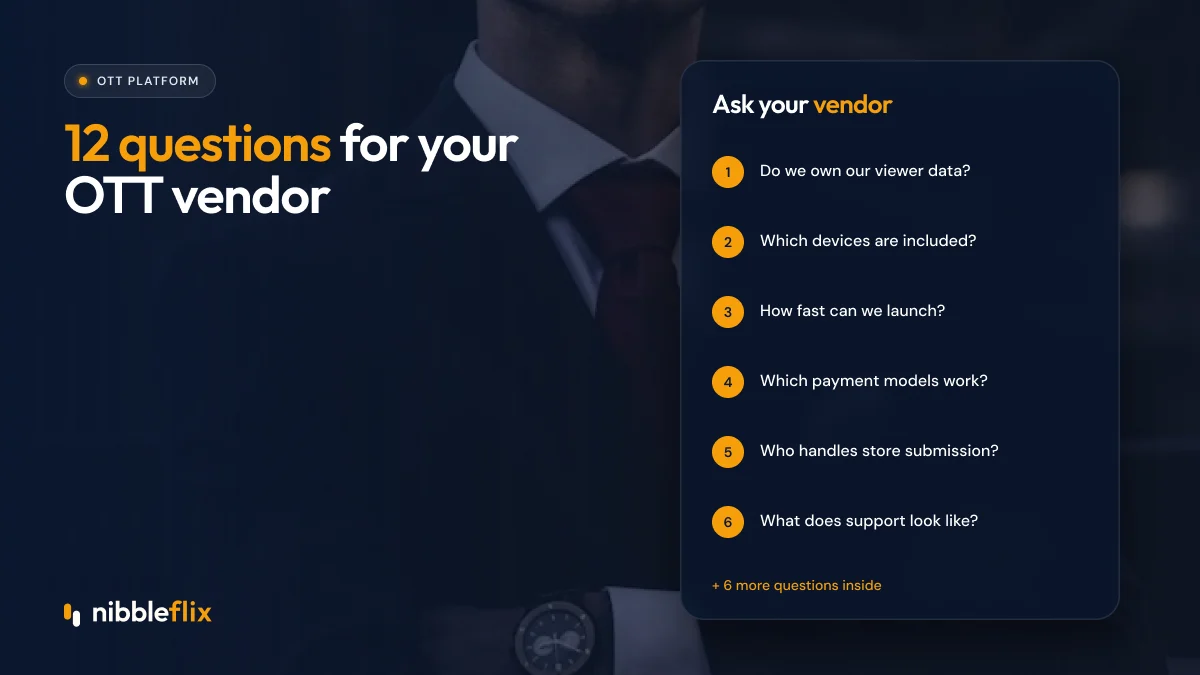
Use the 12 questions below to run a fair OTT platform evaluation and compare vendors on the things that matter after launch, not just in the sales demo.
Finding the best OTT platform provider starts with your needs
Write down three things before you talk to any vendor: your content type (micro-drama, long-form, linear channels or a mix), your target markets, and your launch date. These shape every answer. A vendor that is perfect for a US sports network may be wrong for a micro-drama start-up in Latin America or a broadcaster in the Gulf.
If you still need a full requirements list, start with our OTT platform features checklist.
Ownership and control: questions 1 to 3
1. Will the apps be published under my name?
Some vendors publish apps under their own developer accounts. That makes your business dependent on theirs. Insist that store listings use your brand and your accounts.
2. Who owns the viewer data?
Your subscriber list, viewing history and payment data are your most valuable assets. Confirm you can access and export them at any time.
3. Who collects the revenue?
Check whether payments flow to you directly or through the vendor, and how and when you are paid.
Product fit: questions 4 to 7
4. Which devices are covered out of the box?
Ask for a list of live apps, not a roadmap. A full set covers iOS, Android, web, PWA and smart TVs such as Apple TV, Android TV, Amazon Fire TV, Roku, Samsung and LG. See our device coverage for reference.
5. Which monetization models can I combine?
You may start with subscriptions and later add ads, rentals or coins. Make sure hybrid models work in one app without custom work.
6. Does it support my format?
Micro-dramas need a vertical 9:16 player with swipe navigation and episode unlocks. FAST channels need EPG and server-side ad insertion. Long-form OTT needs strong TV apps and DRM.
7. What AI and localization tools are included?
If you plan to reach several markets, AI subtitles, AI dubbing and AI metadata can save months of work.
Launch and operations: questions 8 to 10
8. How long until my apps are in the stores?
Ask for a week-by-week plan. Some platforms need months. Others can reach App Store and Google Play submission in about seven days.
9. Can my team run it without developers?
Ask to try the admin dashboard yourself. Upload an episode, set a price and schedule a release. If that needs technical help, daily operations will too.
10. What support do I get at launch and after?
Find out whether you get a named contact, how fast support responds, and whether launch support is included or extra. Compare this with what is listed on each vendor’s features and pricing pages.
Commercial and risk: questions 11 and 12
11. How is pricing structured as I grow?
Model the cost at today’s audience and at ten times that size. Look for bandwidth charges, revenue shares and per-device fees that only appear at scale. Our OTT platform cost breakdown explains what to ask.
12. Can I migrate in, and out?
If you already have a service, ask how the vendor will move your content and subscribers without downtime. Also ask what happens if you leave. A confident vendor will not lock in your data.
OTT vendor comparison scorecard
Score each vendor from 1 to 5 on these areas and weight them by what matters most to your business.
| Area | Questions | What a strong answer looks like |
|---|---|---|
| Ownership | 1 to 3 | Your store accounts, your data, your revenue |
| Product fit | 4 to 7 | All key devices and models live today |
| Launch and operations | 8 to 10 | Fast launch, no-code dashboard, named support |
| Commercial and risk | 11 to 12 | Clear pricing at scale, easy migration |
Red flags when you choose a streaming platform
- Apps published under the vendor’s brand or developer account
- No way to export subscriber data
- Key devices listed as “coming soon”
- Every small change requires a paid change request
- Pricing that is unclear until you sign
- Demos that only show slides, not a working dashboard
Comparing white label OTT vendors
White label OTT vendors differ most on ownership, device coverage and speed. NibbleFlix is fully white-label: your brand, your store listings under your name, your viewer data and your revenue. It supports micro-drama, entertainment OTT, FAST channels and AI streaming on one platform, with apps for mobile, web and the major smart TVs.
You can launch in about seven days with no code and launch support included. If you are moving from another system, our migration service keeps your integrations and avoids viewer downtime. Founding partners get first-year pricing locked, a dedicated launch manager and priority on feature requests.
Key takeaways
- The best OTT platform provider fits your content, markets and team.
- Ownership of brand, data and revenue should be non-negotiable.
- Check devices and monetization that are live today, not on a roadmap.
- Test the dashboard yourself and model pricing at scale.
- Ask about migration in and out before signing.
Ready to put NibbleFlix through these 12 questions? Book a demo and bring your scorecard.
Frequently asked questions
How do I find the best OTT platform provider for my business?
Start by defining your content type, target markets and launch date. Then ask each vendor the same questions about ownership, devices, monetization, launch speed, support and pricing at scale. Score the answers, test each dashboard yourself, and choose the provider that fits your plan rather than the longest feature list.
What is a white-label OTT vendor?
A white-label OTT vendor provides a ready-made streaming platform that you launch under your own brand. The apps, store listings and viewer experience carry your name, while the vendor runs the technology. It lets content owners launch quickly without building or maintaining their own video stack.
How long should an OTT platform evaluation take?
A focused evaluation usually takes a few weeks. Shortlist three or four vendors, send the same questions to each, run live demos, and test the dashboards. Avoid stretching the process for months, since every week of delay is a week without revenue or viewer feedback.
Should I choose a vendor with the most features?
Not necessarily. Unused features add complexity without value. Focus on the features your content and markets need, plus ownership, ease of use and support. A vendor that covers your must-haves well and lets you add more later is usually a better choice than one that promises everything.