
In this article
- The two ways to pay for a streaming platform
- OTT platform cost: line-by-line breakdown
- OTT app development cost
- Hidden app costs to budget for
- CDN and hosting costs
- Cost to start a streaming service beyond technology
- Content
- Store and payment fees
- Localization
- Marketing
- Video streaming platform pricing models
- How NibbleFlix keeps launch costs low
- Key takeaways
- Frequently asked questions
- What is the biggest cost when starting a streaming service?
- Why do OTT platform quotes vary so much?
- How can I reduce CDN and hosting costs?
- Do I need to pay app store commission on every sale?
Ask five vendors about OTT platform cost and you will get five quotes that are impossible to compare. One includes smart TV apps, another charges separately for bandwidth, a third takes a revenue share. The only way to budget properly is line by line.
The direct answer: your total OTT platform cost is the sum of platform or development fees, video encoding and storage, CDN delivery, DRM and security, app store and payment fees, content, and marketing, and the balance between them depends mostly on whether you build or license.
This guide breaks down each line item, explains how it is billed, and shows where founders usually underestimate.
The two ways to pay for a streaming platform
Before the line items, decide your approach, because it changes the shape of every cost below.
- Custom build: high upfront spend on development, then ongoing salaries, cloud bills and maintenance.
- Licensed platform (SaaS or white-label): low upfront spend, then a recurring fee, sometimes with usage-based charges for bandwidth or storage.
If you have not made that call yet, read our guide on build vs buy for OTT platforms first.
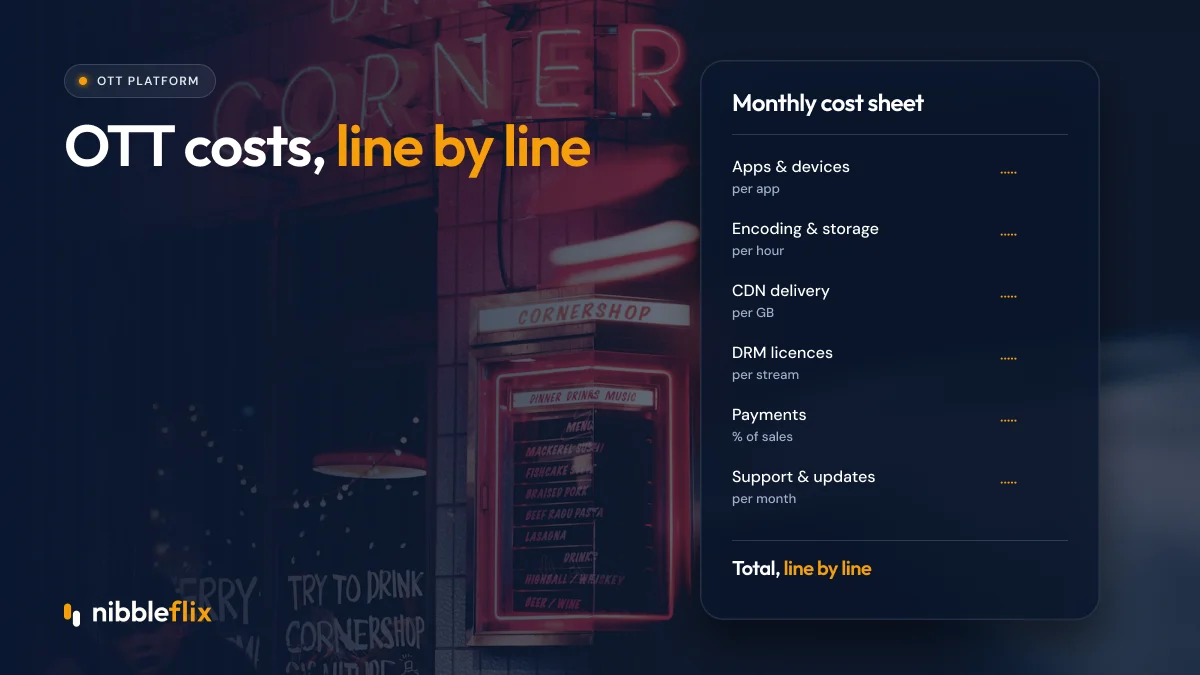
OTT platform cost: line-by-line breakdown
| Cost line | How it is usually billed | What drives it up |
|---|---|---|
| Platform licence or development | Monthly fee, revenue share, or project cost | Number of apps, custom features |
| App development per device | Included in SaaS, or per app if built | Each extra smart TV platform |
| Encoding and transcoding | Per minute of video processed | Catalog size, number of renditions |
| Storage | Per GB per month | Library size, 4K masters |
| CDN and hosting | Per GB delivered | Viewers, watch time, video quality |
| DRM and security | Per licence request or flat fee | Premium content, studio requirements |
| Payments and app stores | Percentage of each transaction | Share of revenue sold in-app |
| Content | Licence fees, production budgets | Exclusivity, originals, territories |
| Localization | Per minute or per language | Number of languages and markets |
| Marketing | Ad spend, creative, ASO | Competition in your genre and region |
OTT app development cost
Apps are where custom builds get expensive. A modern service usually needs iOS and Android apps, a responsive website, and smart TV apps for Apple TV, Android TV, Amazon Fire TV, Roku, Samsung and LG. Each TV platform has its own technology, design rules and review process.
When you build, every app is a separate project with its own testing and updates. When you license, these apps are normally included and maintained by the vendor. A Progressive Web App (PWA) can also cover some mobile use cases without a separate store release.
Hidden app costs to budget for
- Annual updates for new iOS, Android and TV operating systems
- App store developer accounts in your own name
- Re-submissions when store policies change
- QA across many phone and TV models
CDN and hosting costs
Delivery is usually the cost that grows fastest with success. CDN providers charge for every gigabyte sent to viewers, so the bill depends on how many people watch, for how long, and at what quality.
Three levers keep delivery spend under control:
- Adaptive bitrate streaming so viewers on phones get smaller files than viewers on 4K TVs.
- Efficient encoding that reduces file size without visible quality loss.
- Regional CDN coverage close to your audience in Europe, LATAM, MENA or Asia Pacific, which improves playback and can lower costs.
Ask every vendor whether bandwidth is included, capped or billed per GB. This single question explains most of the difference between quotes.
Cost to start a streaming service beyond technology
Technology is often not the largest line. Founders regularly underestimate these:
Content
Licensing or producing content is usually the biggest budget item. Micro-drama originals are cheaper per title than long-form series, which is one reason the format attracts new entrants. Our guide to micro drama content licensing explains the options.
Store and payment fees
Apple and Google charge a commission of up to 30% on in-app purchases and subscriptions. Payment processors charge a smaller fee on web transactions. Your mix of in-app and web sales directly changes your margin.
Localization
Subtitles and dubbing used to be a large cost per language. AI subtitles in 12 languages and AI dubbing cut this sharply, which makes multi-market launches realistic for smaller teams.
Marketing
Plan a user acquisition budget from day one. Trailers, store listings and paid social all cost money, and AI trailer generation can reduce the creative cost of each new title.
Video streaming platform pricing models
When comparing vendors, you will see a few common pricing structures:
- Flat monthly fee: predictable, often with usage limits.
- Tiered plans: pricing grows with subscribers, storage or features.
- Revenue share: lower fixed cost, but the vendor takes a cut as you grow.
- Setup fee plus monthly: covers onboarding and app publishing.
Compare them over three years at your realistic audience size, not at launch size. A plan that looks cheap at 1,000 viewers can become expensive at 100,000.
How NibbleFlix keeps launch costs low
NibbleFlix bundles the apps, CMS, monetization and AI tools into one platform, so you do not pay for separate development projects. You can launch your own streaming app in about seven days with no code and no in-house tech team, and launch support is included.
The features page lists what is included, and the pricing page explains current plans. Founding partners get launch pricing locked for the first year, which makes early budgeting simpler. AI subtitles, dubbing, metadata and trailers are covered on the AI streaming page.
Key takeaways
- Break OTT platform cost into line items before comparing quotes.
- Apps for every device and CDN delivery are the biggest technology variables.
- Content, store commission and marketing often outweigh technology costs.
- Model costs over three years at realistic audience size.
- A licensed platform turns large upfront development into a predictable fee.
Want a cost estimate for your service? Book a demo and we will walk through each line with you.
Frequently asked questions
What is the biggest cost when starting a streaming service?
For most services, content is the largest cost, followed by marketing. On the technology side, building apps for every device and paying for CDN delivery are the biggest items. Licensing a platform reduces the technology share so more of your budget can go into content and audience growth.
Why do OTT platform quotes vary so much?
Vendors include different things. Some quotes cover smart TV apps, bandwidth, DRM and support, while others charge for each separately or take a revenue share. Ask every vendor for a line-by-line breakdown and model the cost at your expected audience size over three years before comparing.
How can I reduce CDN and hosting costs?
Use adaptive bitrate streaming, efficient encoding and a CDN with strong coverage in your viewers’ regions. Avoid storing unnecessary renditions, and archive titles nobody watches. Check whether your platform includes bandwidth in its fee, since usage-based billing grows quickly as your audience expands.
Do I need to pay app store commission on every sale?
Apple and Google charge a commission of up to 30% on digital purchases made inside their apps, with reduced rates in some cases. Sales made on your website use a payment processor instead, which usually costs less. Rules differ by country and change often, so check current store terms.